Special PCB manufacturing for metal core, ceramic, flex, and RF board types

Specialty PCB Types

Specialty PCB Manufacturing - Beyond Standard FR-4

When your design goes beyond standard FR-4, APTPCB manufactures each specialty board type with substrate-specific processing knowledge, dedicated equipment, and the same engineering rigor applied to our standard product lines. Our capability covers metal core substrates for thermal management, ceramic boards for extreme environments, flexible polyimide circuits, gold finger connectors, carbon ink structures, PTFE laminates for RF and microwave frequencies, and other special constructions for demanding electronics.

Al / Cu MCPCB
Metal Core Substrates
DuPont / Panasonic
Flex Materials
Rogers / Taconic
HF Laminates

Get an Instant Quote

Al / Cu MCPCBMetal Core
1.0-8.0 W/mKThermal Conductivity
Flex / Rigid-FlexPolyimide
Gold FingerHard Gold 0.5-2.5 um
Carbon InkPrinted Resistors
Rogers / TaconicRF / PTFE
CeramicAl2O3 / AlN
UL ListedSafety Certified
Al / Cu MCPCBMetal Core
1.0-8.0 W/mKThermal Conductivity
Flex / Rigid-FlexPolyimide
Gold FingerHard Gold 0.5-2.5 um
Carbon InkPrinted Resistors
Rogers / TaconicRF / PTFE
CeramicAl2O3 / AlN
UL ListedSafety Certified

Metal Core PCB

Specialty PCB Solutions for Power, Thermal & RF Engineers Worldwide

As a manufacturer trusted by LED lighting companies across Southeast Asia, EV power electronics teams in Germany, aerospace designers in California, and industrial drive engineers in northern Europe, APTPCB delivers substrate-specific manufacturing expertise that standard FR-4 fabricators cannot offer. Our specialty PCB lines cover metal core boards, ceramic substrates, flexible polyimide circuits, rigid-flex assemblies, gold finger connectors, carbon ink resistors, high-frequency PTFE laminates, heavy copper up to 20 oz, high-CTI, and halogen-free boards, each processed on dedicated production lines with material-specific recipes.

Aluminum & Copper Base MCPCB
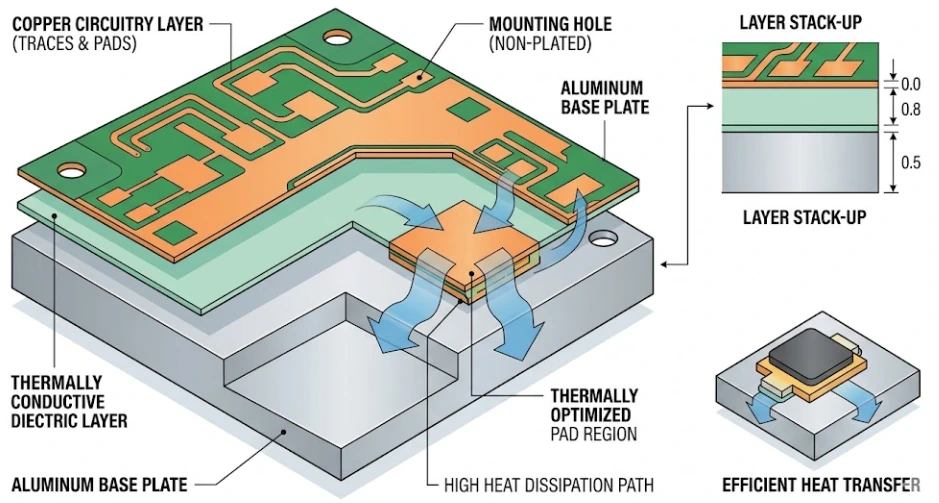
Metal Core PCBs use an aluminum, copper, or iron metal base as structural substrate and thermal spreader, with a thermally conductive dielectric bonding the circuit copper to the metal core. Our MCPCB capability supports 1 to 4 layers with board sizes up to 43.3 x 19 in and thermal conductivity from 1.0 W/mK through 8.0+ W/mK depending on the dielectric system.

Copper & Iron Base MCPCB
Copper-base MCPCBs provide roughly 2x the thermal conductivity of aluminum and are chosen for RF power amplifiers, IGBT modules, and extreme thermal management designs. Iron-base MCPCBs offer superior mechanical strength and are often specified for automotive power modules and industrial motor-drive controllers. Our MCPCB line includes specialized drilling, routing, and surface finish processing optimized for metal substrates.

Metal core PCBs for LED thermal management and power electronics

Specialty PCB Types

Complete Specialty PCB Manufacturing Capabilities

Detailed specifications for each special PCB type we manufacture. Each type requires substrate-specific processing knowledge and dedicated equipment.

PCB TypeSubstrate MaterialKey CapabilityPrimary Applications
Aluminum MCPCBAl 5052 / 6061 base, Bergquist / Laird / Ventec / Totking IMS and equivalents1.0–3.0 W/mK, 1–4 layers, up to 43.3" × 19"LED lighting, power supplies, motor drives
Copper MCPCBCu C11000 base, premium IMS dielectric3.0–8.0+ W/mK, 1–4 layersHigh-power LED, RF PA, IGBT modules, EV power
Iron-Base MCPCBFe base plate, thermally conductive dielectricMechanical strength + thermal managementAutomotive power modules, industrial motor drives
Ceramic PCBAl₂O₃ (Alumina), AlN (Aluminum Nitride)24–170 W/mK, DBC/DPC/LTCCPower modules, sensors, high-temp, space, laser diodes
Flex PCBPolyimide — DuPont Pyralux, Panasonic Felios, Shengyi, Taiflex, Doosan, and equivalents1–8 layers, RA/ED copper, coverlayWearables, medical, automotive, FPC cables
Rigid-Flex PCBFR-4 rigid + PI flex, adhesiveless and adhesive constructionUp to 32 layers, 2/2 mil, bookbinderSmartphones, aerospace, medical implants, avionics
Gold Finger PCBStandard FR-4, high-Tg, or specialty substratesHard gold 0.5–2.5 μm over 3–5 μm Ni, beveledEdge connectors, test cards, memory modules, PCIe/DDR slots
Carbon Ink PCBStandard FR-4 with screen-printed carbonPrinted carbon resistors, contacts, jumpersKeyboards, remote controls, consumer devices, keypads
High-Frequency PTFERogers, Taconic, Arlon, Isola Astra, and equivalentsDk 2.2-10.2, Df 0.0009-0.004, hybrid stack-ups5G mmWave, automotive radar, satellite, RF/microwave
Heavy Copper PCBHigh-resin FR-4 or polyimide, any substrate per BOM3–20 oz copper, mixed weights, 2–10 layersEV charging, solar inverters, welding, UPS, planar transformers
High-CTI PCBHigh-CTI FR-4 (CTI ≥ 600V)High voltage isolation, safety-criticalPower supplies, mains-connected equipment
Halogen-Free PCBHalogen-free FR-4, phosphorus/nitrogen retardantEnvironmental compliance, low smokeConsumer, automotive, EU market products

The materials listed above are representative examples. APTPCB supports mainstream specialty substrates across the market and can source commercially available materials per your BOM. Some specialty types can also be combined in one design, such as rigid-flex with gold fingers, MCPCB with halogen-free dielectric, or hybrid PTFE / FR-4 with heavy copper power layers.

Specialty Technologies

Specialized Manufacturing Processes for Each Board Type

Each specialty PCB type requires unique processing steps beyond standard FR-4 fabrication. These are the critical manufacturing challenges and our process approaches.

01

Flexible PCB - Polyimide Substrate Processing

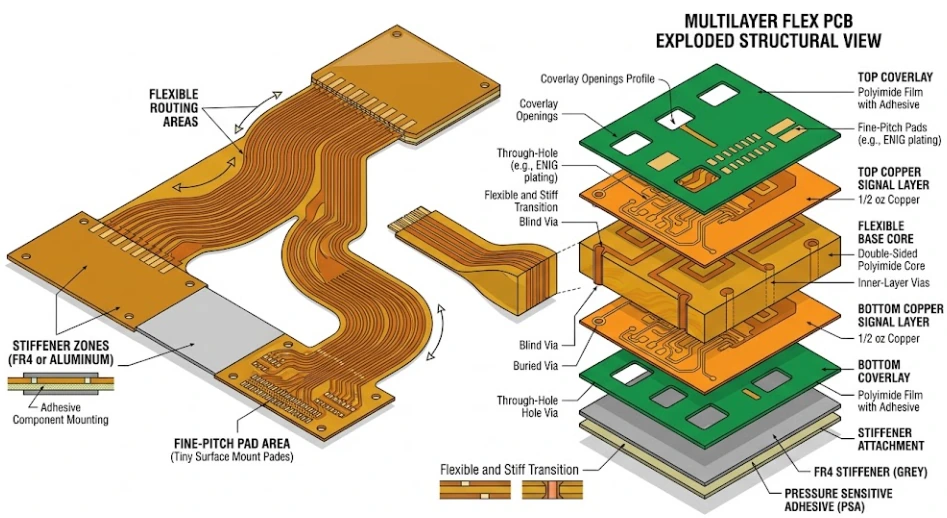
Flexible PCBs built on polyimide (PI) substrates require completely different handling, imaging, and surface treatment processes compared to rigid FR-4. Polyimide is hygroscopic — it absorbs atmospheric moisture rapidly (up to 3% by weight), requiring pre-bake cycles before lamination and reflow to prevent explosive delamination ("popcorning"). Coverlay application replaces solder mask — laser-cut polyimide coverlay provides precise pad openings while maintaining flexibility. We process DuPont Pyralux and Panasonic Felios materials with RA copper for dynamic flex applications and ED copper for static/install-to-fit designs. Supported configurations include single-layer through 6-layer flex, with trace/space down to 2.5/2.5 mil.

02

Gold Finger - Hard Electrolytic Gold Plating

Gold finger boards require hard electrolytic gold plating, typically cobalt-hardened, on the card-edge connector area, with thickness ranging from 0.5 um flash gold for low-insertion applications to 2.5 um heavy gold for connectors rated for 500+ insertions. The gold is plated over a nickel barrier layer 3-5 um thick to prevent gold diffusion into the underlying copper. Our gold-finger process includes precision masking to protect non-plated areas, controlled current density for uniform thickness, beveling of the insertion edge, and XRF thickness verification at multiple points along the finger length.

03

Carbon Ink - Printed Resistor and Contact Technology

Carbon ink PCBs use screen-printed carbon paste to create resistive elements and contact pads directly on the PCB surface. Carbon ink resistors replace discrete resistors in applications where board space is constrained and resistor tolerance requirements are moderate (typically ±20%). Carbon ink contacts replace gold-plated contacts in cost-sensitive consumer products (membrane keyboards, remote controls) where insertion cycles are low. Our carbon ink process controls print thickness, cure temperature, and sheet resistance to achieve target resistance values within specified tolerance. Carbon ink is applied after solder mask and before surface finish, requiring precise registration to underlying copper features.

04

High-Frequency PTFE - Plasma Desmear and RF Processing

PTFE-based high-frequency laminates from Rogers (RO4350B, RO4003C, RO3003, RT/duroid), Taconic (RF-35, TLY, TLX), and Arlon require specialized processing at every fabrication step. PTFE is chemically inert, so standard permanganate desmear cannot activate the hole wall surface and plasma desmear using CF4 / O2 gas mixtures is required. PTFE is also soft and thermoplastic, so drill programs must use reduced spindle speeds and optimized feed rates to minimize smear generation. Hybrid stack-ups combining PTFE signal layers with FR-4 structural layers require compatible bonding systems such as RO4450F prepreg or Rogers 2929 bondply. TDR verification on every panel through our quality assurance workflow confirms that the manufactured impedance matches electromagnetic simulation predictions.

05

Ceramic PCB - Alumina and Aluminum Nitride Substrates

Ceramic PCBs use alumina (Al₂O₃, thermal conductivity ~24 W/mK) or aluminum nitride (AlN, ~170 W/mK) substrates for applications requiring extreme temperature stability, high thermal conductivity, or operation in harsh environments where organic substrates cannot survive. Ceramic substrates are manufactured using DBC (Direct Bonded Copper), DPC (Direct Plated Copper), or LTCC (Low Temperature Co-fired Ceramic) processes — fundamentally different from standard PCB lamination. Ceramic boards are specified for high-power modules, precision sensors, high-temperature electronics (operating above 200°C), and space applications requiring radiation hardness.

06

High-CTI and Halogen-Free - Safety and Environmental Compliance

High-CTI and halogen-free boards process similarly to FR-4 but require validated lamination profiles, confirmed chemistry compatibility, and documented compliance for safety-critical or environmentally regulated products.

Flex PCB Deep Dive

Flexible PCB Manufacturing — Materials, Process, and Design Guidance

Flexible PCBs built on polyimide substrates enable electronic circuits to bend, fold, and conform to three-dimensional shapes that rigid boards cannot accommodate. Our flex PCB manufacturing covers single-layer through 6-layer constructions with both static (install-to-fit) and dynamic (continuous bending) applications.

Material Selection
Rolled Annealed (RA) copper is mandatory for dynamic flex applications — its grain structure runs parallel to the foil surface, providing superior fatigue resistance under repeated bending compared to Electro-Deposited (ED) copper, which has a columnar grain structure prone to crack propagation. Copper weights for flex layers are typically 0.5 oz (18 μm) or 1 oz (35 μm) — thinner copper bends more easily and survives more flex cycles. For the base dielectric, adhesiveless polyimide from DuPont Pyralux or Panasonic Felios is preferred over adhesive-based constructions because it eliminates the acrylic adhesive layer that adds thickness (increasing minimum bend radius) and degrades under high-temperature reflow.

Bend Radius Engineering
The minimum bend radius is determined by the total flex section thickness and whether the application is static or dynamic. Per IPC-2223, static bends require a minimum radius of 10× the flex section total thickness; dynamic bends require 20–40× depending on flex cycle count requirements. For example, a 0.2 mm thick flex section has a minimum static bend radius of 2.0 mm and a minimum dynamic bend radius of 4.0–8.0 mm. Traces in bend zones should be routed perpendicular to the bend axis to minimize tensile/compressive strain along the copper grain direction.

Flex Assembly Considerations
Flex PCB assembly requires specialized handling to prevent damage during pick-and-place, reflow, and downstream processing. Components are placed on stiffened areas where FR-4, polyimide, or stainless steel stiffeners provide a rigid mounting platform. Pre-bake cycles (typically 2–4 hours at 105°C) drive out absorbed moisture before reflow soldering to prevent popcorning delamination. Our cleanroom SMT facility uses dedicated flex carriers and handling procedures to protect flex integrity throughout the assembly process.

Flexible PCB with polyimide substrate, coverlay openings, and stiffener areas

High-Frequency Deep Dive

High-Frequency PCB Manufacturing — PTFE, Hydrocarbon Ceramic, and Hybrid Stack-Ups

High-frequency PCBs for RF, microwave, and millimeter-wave applications require substrate materials with precisely controlled dielectric properties — low and stable dielectric constant (Dk), low dissipation factor (Df), and consistent performance across temperature and frequency ranges. Standard FR-4 is unsuitable for these applications due to its high dielectric loss and poor Dk stability at GHz frequencies.

Material Families We Process
Rogers RO4000 Series (RO4350B, RO4003C): Hydrocarbon ceramic laminates processable with standard FR-4 equipment. Dk 3.38–3.48, Df 0.0027–0.0037. The workhorse materials for sub-6 GHz 5G, Wi-Fi, GPS, and general RF applications. No plasma desmear required.

Rogers RO3000 Series (RO3003): PTFE ceramic laminates for millimeter-wave frequencies. Dk 3.00, Df 0.0010. The de facto standard for 77 GHz automotive radar. Requires plasma desmear for hole wall activation.

Rogers RT/duroid (5880, 6002): Pure PTFE laminates for the lowest possible loss. Df 0.0009–0.0012. Used in satellite, military EW, and precision instrumentation. Requires plasma desmear and modified drill programs.

Taconic and Arlon: Alternative PTFE and composite laminates for specific RF applications. RF-35, TLY, TLX from Taconic; high-temperature laminates from Arlon.

Hybrid Stack-Up Engineering for RF
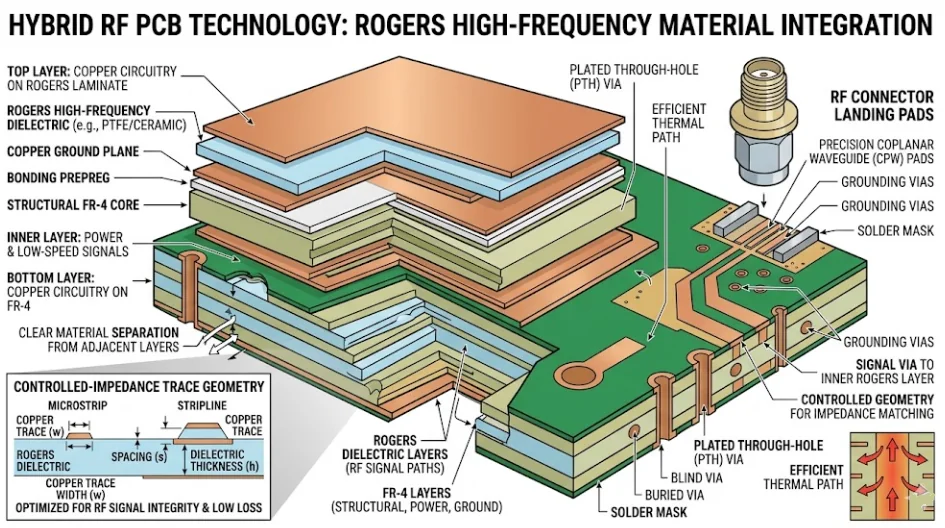
Full Rogers multilayer boards are prohibitively expensive for many applications. Hybrid stack-ups use Rogers cores only on RF signal layers, with standard FR-4 on power/ground and digital layers, bonded using compatible prepreg (RO4450F for RO4000 series, Rogers 2929 for PTFE-to-FR-4). This approach reduces material cost by 30–50% while preserving RF performance on the critical signal layers. Our CAM engineers model impedance continuity at dielectric transitions and validate bonding system compatibility.

High-frequency PCB with hybrid Rogers and FR-4 stack-up

Applications

Industry Applications for Special PCB Types

Each specialty PCB type serves applications where standard FR-4 boards cannot meet the thermal, mechanical, electrical, or environmental requirements.

LED & Lighting

Metal Core for Thermal Management

High-power LED luminaires, automotive headlamps, architectural lighting, and display backlights use aluminum-base MCPCBs to extract heat from LED junctions and maintain operating temperatures within specification. Thermal conductivity of 1.0–3.0 W/mK is typical for LED applications. Board designs include optimized thermal pad geometries, thermal via arrays (in hybrid MCPCB/FR-4 designs), and surface finishes compatible with LED soldering (typically ENIG or OSP). Volume production of LED MCPCBs is price-sensitive and demands optimized panelization and material utilization.

Automotive Radar

77 GHz PTFE Antenna Arrays

Automotive ADAS radar sensors operating at 77 GHz require PTFE-based substrates (Rogers RO3003) for the antenna array board due to the material's low loss tangent and excellent Dk stability across the automotive temperature range (-40°C to +85°C). These boards combine RO3003 antenna layers with FR-4 digital processing layers in hybrid stack-ups, with plasma desmear for PTFE via processing and TDR verification of impedance structures critical to antenna pattern performance.

Consumer Electronics

Flex and Carbon Ink for Compact Devices

Smartphones, tablets, wearables, and IoT devices use flexible PCBs for cable replacement, hinge connections, and conformal sensor arrays. Carbon ink PCBs are used in keyboards, remote controls, and membrane switches where printed carbon contacts and resistors reduce component count and board size. Consumer applications prioritize high-volume manufacturing efficiency, consistent quality at tight cost targets, and supply chain reliability.

5G & Telecom

High-Frequency Hybrid Stack-Ups

5G massive MIMO antenna panels, base-station RF front-ends, and satellite communication equipment use hybrid Rogers / FR-4 stack-ups to combine low-loss RF signal routing with standard digital and power-distribution layers. Sub-6 GHz applications typically use RO4350B, while millimeter-wave applications use RO3003 or Megtron 7. Impedance-controlled feed networks require TDR verification, and antenna applications may require PIM screening with ENEPIG surface finish.

Power Electronics

Copper Core and Ceramic for High Power

Power semiconductor modules for EV inverters, industrial drives, and power conversion equipment use copper-base MCPCBs or ceramic (DBC) substrates for maximum thermal extraction from IGBT, SiC MOSFET, and GaN transistor packages. Ceramic AlN substrates (170 W/mK) provide the highest thermal performance for the most demanding power density applications. These boards must withstand continuous operating temperatures exceeding 125°C and thermal cycling between -40°C and +150°C without delamination.

Medical & Wearable

Flex and Rigid-Flex for Body-Worn Devices

Wearable health monitors, implantable devices, hearing aids, and medical probes use flexible and rigid-flex PCBs to conform to body contours, survive repeated bending during daily use, and minimize size and weight. Medical flex applications require ISO 13485-aligned quality systems, biocompatible surface finishes, and comprehensive traceability. Dynamic flex designs must pass documented bend testing per application-specific requirements, often 100,000+ flex cycles.

Selection Guide

How to Select the Right Special PCB Technology

Choosing the correct specialty PCB type begins with identifying the primary design constraint that standard FR-4 cannot satisfy. Each specialty type addresses one or more specific limitations of conventional PCB construction.

Thermal Constraint - Metal Core or Ceramic

If your primary challenge is heat extraction from high-power devices and standard FR-4 thermal-via arrays are insufficient, metal core or ceramic substrates become the logical upgrade. Aluminum MCPCB covers most LED and moderate-power applications, copper MCPCB extends thermal performance, and ceramic supports the most extreme thermal density and temperature environments.

Mechanical Constraint - Flex or Rigid-Flex

If the board must bend, fold, or conform to a non-planar surface, flexible or rigid-flex construction is required. Pure flex PCBs (1–6 layers) are appropriate when the entire circuit is flexible — cable replacements, sensor arrays, wearable conformals. Rigid-flex is appropriate when some areas need rigid component support while other areas must flex — smartphones, aerospace avionics, medical instruments with hinged sections.

Electrical Constraint - High-Frequency Materials

If your operating frequency exceeds roughly 1 GHz and FR-4 dielectric loss becomes unacceptable, high-frequency laminates are required. The choice between Rogers RO4000, RO3000 / RT-duroid, and Taconic or Arlon alternatives depends on loss budget, frequency range, and cost sensitivity. Hybrid RF stack-ups are often the most practical answer.

Interface Constraint - Gold Finger

If the board uses card-edge connectors for insertion into backplanes, test equipment, or expansion slots, hard gold plating on the connector fingers is required for wear resistance and reliable contact over hundreds or thousands of insertion cycles. Gold thickness specification depends on the target insertion cycle count — flash gold (0.5 μm) for low-cycle applications, heavy gold (2.0–2.5 μm) for high-cycle applications.

Cost Constraint - Carbon Ink

If your design includes many low-precision resistors or contact switches that could be replaced by printed elements, carbon ink technology reduces component count, eliminates placement and soldering steps for those components, and saves board area. Carbon ink is most cost-effective in high-volume consumer products where per-unit savings are multiplied across large production runs.

Combined Constructions

Combining Multiple Specialty Technologies

Many products require combinations of specialty technologies within a single board or product assembly. Common examples include rigid-flex with gold fingers, MCPCB with halogen-free dielectric systems, high-frequency hybrid stack-ups with heavy-copper power layers, and flex interconnects integrated into high-frequency assemblies. These combinations create process interactions that must be reviewed before production release.

Our engineering team evaluates the complete process-compatibility checklist before committing the board to fabrication: bonding-system compatibility between dissimilar materials, drill and plating sequence for mixed via structures, surface-finish interaction with specialty materials, registration tolerances through multiple lamination cycles, and any conflicting process windows that a standard FR-4 workflow would miss. This feasibility review is critical before manufacture.

MCPCB Specifications

Metal Core PCB Detailed Specifications

Comprehensive technical specifications for our metal core PCB manufacturing capability.

ParameterAluminum BaseCopper BaseNotes
Base MaterialAl 5052 / 6061Cu C11000Standard alloys for thermal management
Base Thickness1.0 – 3.2 mm1.0 – 3.2 mmCustom thicknesses available
Dielectric Thickness75 – 200 μm75 – 150 μmThinner dielectric = lower thermal resistance
Thermal Conductivity1.0 – 3.0 W/mK3.0 – 8.0 W/mKDielectric material dependent
Dielectric Breakdown≥ 3 kV≥ 3 kVIPC-TM-650 testing
Circuit Layers1 – 2 layers1 – 2 layersCOB and chip-on-board compatible
Copper Weight1 oz – 4 oz1 oz – 4 ozHeavy copper for high current paths
Minimum Trace / Space4 / 4 mil4 / 4 milStandard FR-4 etching capability
Surface FinishLF-HASL, ENIG, OSP, Imm Ag, Imm SnLF-HASL, ENIG, OSP, Imm Ag, Imm SnENIG recommended for LED wire bond
Solder MaskWhite (LED reflective), green, blackWhite (LED reflective), green, blackWhite maximizes LED optical efficiency
UL Rating94V-094V-0Standard for lighting products
Panel SizeUp to 18 × 24 inchesUp to 18 × 24 inchesPanel utilization optimized for unit cost

MCPCB thermal performance is primarily determined by the dielectric layer — thinner dielectric with higher thermal conductivity provides lower thermal resistance but may limit voltage isolation. Our engineering team helps select the optimal dielectric system based on your thermal dissipation requirements and voltage isolation needs.

FAQ

Frequently Asked Questions — Special PCB Manufacturing

What thermal conductivity values are available for metal core PCBs?
Aluminum-base MCPCBs are available with dielectric thermal conductivity from 1.0 W/mK (standard) to 3.0 W/mK (mid-range). Copper-base MCPCBs offer 3.0–8.0 W/mK using premium dielectric systems from Bergquist and Laird. The choice depends on your thermal dissipation requirements, component junction temperature targets, and cost sensitivity.
Can you manufacture ceramic PCBs?
Yes. We support ceramic PCB technologies including DBC (Direct Bonded Copper) on alumina (Al₂O₃) and aluminum nitride (AlN) substrates, DPC (Direct Plated Copper), and LTCC (Low Temperature Co-fired Ceramic). Ceramic substrates are specified for extreme-temperature applications, high-power modules, and environments where organic substrates cannot survive.
What flex PCB configurations do you support?
We manufacture single-layer through 6-layer flexible PCBs using DuPont Pyralux and Panasonic Felios polyimide materials. Rolled Annealed (RA) copper is used for dynamic flex applications; ED copper is acceptable for static/install-to-fit. We support coverlay and flexible solder mask (LPI), stiffener application (FR-4, PI, stainless steel), and adhesiveless polyimide construction for superior flex life and thinner profiles.
What is the gold thickness range for gold finger boards?
We plate gold fingers from 0.5 μm (flash gold, suitable for low-insertion applications) to 2.5 μm (heavy gold, rated for 500+ insertion cycles). Gold is deposited by electrolytic plating over a 3–5 μm nickel barrier layer. Gold thickness is verified by XRF measurement at multiple points. Edge beveling (20° or 30°) is available for smooth connector insertion.
What high-frequency materials do you process?
We process the full range of Rogers laminates including RO4350B, RO4003C, RO3003, and RT/duroid 5880 / 6002, along with Taconic RF-35, TLY, TLX, Arlon materials, Isola Astra, and equivalent PTFE or ceramic-filled laminates. PTFE materials require plasma desmear during fabrication, and hybrid stack-ups combining HF signal layers with FR-4 structural layers are often used to reduce cost while preserving RF performance.
When should I use carbon ink instead of discrete components?
Carbon ink is most effective for replacing large numbers of low-precision resistors (±20% tolerance) or contact switches in high-volume consumer products. Common applications include membrane keyboards, remote controls, and touch-panel interfaces. Carbon ink saves component cost, placement cost, and board area, but is limited by tolerance and power handling. Our engineering team evaluates whether carbon ink is suitable for your specific resistance values and tolerance requirements.
Can you combine multiple specialty technologies in one board?
Yes. Common combinations include rigid-flex with gold fingers, MCPCB with halogen-free dielectric, high-frequency hybrid stack-ups with rigid-flex, and flex with carbon ink contacts. Each combination is reviewed for process compatibility before production.
What certifications do your specialty PCBs carry?
All specialty PCB types are manufactured under our ISO 9001 quality system. Automotive applications align with IATF 16949, medical projects with ISO 13485 expectations, UL listing covers standard and metal-core boards, and IPC-6012 / IPC-6013 acceptance is applied according to board type and reliability class.

Global Engineering Reach

Specialty PCB Manufacturing for Engineers Worldwide

Engineering teams across LED lighting, automotive radar, medical devices, aerospace, and consumer electronics rely on APTPCB for specialty PCB fabrication.

North America
USA - Canada - Mexico

LED lighting manufacturers sourcing aluminum MCPCBs at volume, medical device startups requiring flex and rigid-flex prototypes with ISO 13485 alignment, defense contractors needing PTFE high-frequency boards with plasma desmear and IPC Class 3 documentation, and EV power electronics suppliers sourcing heavy copper and embedded copper coin boards for inverter modules.

LED MCPCBMedical FlexRF / PTFE
Europe
Germany - UK - France - Nordic

Automotive Tier-1 suppliers use 77 GHz radar boards, industrial manufacturers deploy heavy-copper power designs, lighting companies source high-volume aluminum MCPCB, and telecom teams prototype hybrid Rogers / FR-4 antenna panels.

77 GHz RadarHeavy CopperLED Volume
Asia-Pacific
Japan - South Korea - Taiwan - India

Consumer electronics brands sourcing flex PCBs for smartphones and wearables at mass production volumes, 5G infrastructure suppliers needing hybrid Rogers/FR-4 antenna panels, semiconductor companies requiring ceramic substrates for power module evaluation boards, and IoT manufacturers using carbon ink PCBs for cost-optimized input devices in high-volume consumer products.

Flex Volume5G HybridCeramic
Israel & Middle East
Israel - UAE - Saudi Arabia

Aerospace and defense programs requiring PTFE high-frequency boards for radar and electronic warfare systems, satellite communication boards with embedded copper coin thermal management, and LED lighting projects for smart city infrastructure and solar-powered outdoor deployments across the Middle East region.

Defense RFSATCOMSmart Lighting

Ready to Build Your Specialty PCB?

Whether you need metal core thermal management, flexible polyimide circuits, PTFE high-frequency boards, or gold finger connectors — share your requirements and we will provide DFM guidance, material recommendations, and competitive quotation within one business day.