PCB Fabrication Process

Fabrication Processes for Every Technology

High-Precision PCB Manufacturing

At the heart of every cutting-edge electronic product lies a high-performance PCB. We specialize in a broad range of PCB types, including Multilayer, HDI, Rigid-Flex, and Ceramic boards, designed to meet the most demanding requirements.

Get an Instant Quote

High-Precision PCB Manufacturing for Your Unique Project Needs

At the heart of every cutting-edge electronic product lies a high-performance PCB. As a critical component in electronics, the manufacturing process of your PCB directly affects its reliability, functionality, and overall success. We specialize in a broad range of PCB types, including single-sided, double-sided, multilayer, flexible, and rigid-flex boards, designed to meet the most demanding requirements of industries such as consumer electronics, automotive, medical devices, telecommunications, and LED lighting.

Our PCB manufacturing processes are meticulously crafted to match your precise project needs. Whether you're looking for High-Density Interconnect (HDI) boards, gold fingers, ceramic PCBs, or metal core boards, our team ensures that every product we create meets the highest standards of quality, performance, and reliability, while adhering to your timeline and budget constraints.

Different Types of PCBs and Their Fabrication Processes

Multilayer PCB + Resin Plug Process (POFV / VIPPO)

Application: Designs requiring Via-in-Pad for BGAs or high-pressure vacuum air-tightness.

Phase 1: Core & Inner Layers

  • Cut Laminate & Baking
  • Inner Layer Dry Film โ†’ Etching โ†’ Strip Film
  • Inner Layer AOI
  • Brown Oxide
  • Lamination (Lay-up & Vacuum Pressing)
  • X-Ray Drilling
โ†’

Phase 2: Via Prep & Plugging

  • Drill 1 (Through / Buried for Plugging)
  • Deburring & Desmear
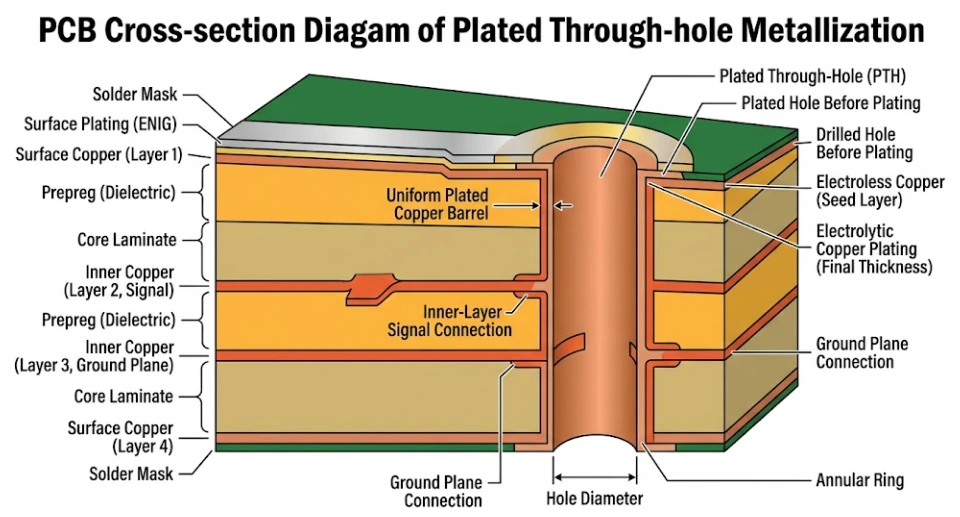
  • Electroless Copper (PTH)
  • Panel Plating 1 (Thicken Hole Cu)
  • Resin Plugging (Vacuum) โ†’ Baking & Curing
  • Planarization (Remove excess resin)
โ†’

Phase 3: Cap Plating & Pattern

  • Drill 2 (Non-plugged Through Holes)
  • Desmear
  • Electroless Copper (Cap Plating)
  • Panel Plating 2 (Cap Flatness)
  • Outer Layer Dry Film โ†’ Pattern Plating
  • Outer Layer Etching โ†’ Outer Layer AOI
โ†’

Phase 4: Mask, Finish & QA

  • Solder Mask
  • Legend (Silkscreen)
  • Surface Finish (ENIG / OSP)
  • Profiling (Routing / V-Cut)
  • E-Test โ†’ FQC
  • Packaging
โ†’

HDI Type I Process (1+N+1)

Application: Smartphones, consumer electronics using Laser Blind Vias.

Phase 1: Process Steps (Part 1)

  • Core Fabrication: Cut Laminate
  • Inner Layer Dry Film
  • Inner Layer Etching
  • Inner Layer AOI
  • Brown Oxide
  • Build-up & Laser Drilling: Lamination 1 (Core + RCC or Prepreg/Foil)
โ†’

Phase 2: Process Steps (Part 2)

  • Laser Drilling (Blind Vias L1-L2)
  • Mechanical Drilling (Through Holes)
  • Plasma Desmear (Remove Laser Carbon)
  • Electroless Copper
  • VCP Plating (Blind Via Filling)
  • Outer Layer Dry Film
โ†’

Phase 3: Process Steps (Part 3)

  • Pattern Plating
  • Outer Layer Etching
  • Outer Layer AOI
  • Solder Mask
  • Legend
  • Surface Finish
โ†’

Phase 4: Process Steps (Part 4)

  • Profiling
  • E-Test
  • FQC
  • Packaging
โ†’

HDI Type II Process (2+N+2)

Application: Tablets, 5G Modules, High-density logic boards. Involves two build-up cycles.

Phase 1: Process Steps (Part 1)

  • Core Fabrication: Cut Laminate
  • Inner Layer Dry Film
  • Inner Layer Etching
  • Inner Layer AOI
  • Brown Oxide
  • 1st Build-up (Type I Stage): Lamination 1
  • Laser Drilling 1 (L2-L3, Ln-1 to Ln-2)
  • Mechanical Drill (Buried Vias)
โ†’

Phase 2: Process Steps (Part 2)

  • Desmear
  • Electroless Copper
  • VCP Plating (Fill Vias)
  • Inner Layer Patterning 2 (Dry Film/Etch/AOI)
  • Brown Oxide
  • 2nd Build-up (Type II Stage): Lamination 2 (1st Stage Board + PP + Outer Foil)
  • X-Ray Drilling
  • Laser Drilling 2 (L1-L2, Ln to Ln-1)
โ†’

Phase 3: Process Steps (Part 3)

  • Mechanical Drilling (Through Holes)
  • Plasma Desmear
  • Electroless Copper
  • VCP Plating (Fill Blind Vias & Plate Through Holes)
  • Outer Layer Dry Film
  • Pattern Plating
  • Outer Layer Etching
  • Outer Layer AOI
โ†’

Phase 4: Process Steps (Part 4)

  • Solder Mask
  • Legend
  • Surface Finish
  • Profiling
  • E-Test
  • FQC
โ†’

Rigid-Flex PCB Process (4-Layer Example)

Application: Wearables, Aerospace, Medical devices.

Phase 1: Process Steps (Part 1)

  • Flex Core (FPC) Fabrication: Cut Flex Laminate (FCCL)
  • Chemical Clean
  • FPC Dry Film
  • FPC Etching
  • FPC AOI
  • Coverlay Lamination
  • Pressing & Curing
  • Surface Finish (on Flex Pads)
โ†’

Phase 2: Process Steps (Part 2)

  • FPC Punching/Cutting
  • Rigid Prep & Lamination: Cut Rigid Laminate
  • Mill No-Flow Prepreg (Open windows for flex area)
  • Brown Oxide
  • Stack-up (Rigid + PP + FPC + PP + Rigid)
  • Vacuum Lamination
  • Laser Trimming (Remove excess glue)
  • Drilling & Outer Layers: Drilling
โ†’

Phase 3: Process Steps (Part 3)

  • Plasma Cleaning (Roughen PI hole walls)
  • Electroless Copper
  • Panel Plating
  • Outer Layer Dry Film
  • Pattern Plating
  • Outer Layer Etching
  • Solder Mask
  • Legend
โ†’

Phase 4: Process Steps (Part 4)

  • Surface Finish
  • Laser Opening (Remove Rigid Cap over Flex Area)
  • Controlled Depth Routing
  • E-Test
  • FQC
โ†’

Metal Core PCB (MCPCB) - Single Sided

Application: LED Lighting, Power Modules.

Phase 1: Process Steps (Part 1)

  • Cut Aluminum Laminate
  • Scrubbing
  • Dry Film (Imaging)
  • Acid Etching
  • Strip Film
โ†’

Phase 2: Process Steps (Part 2)

  • Etching Inspection
  • Solder Mask (High Reflectivity White Ink)
  • Legend
  • Surface Finish (HASL/OSP)
  • Hi-Pot Test (High Voltage Insulation Test)
โ†’

Phase 3: Process Steps (Part 3)

  • Profiling (V-Cut / CNC Routing / Punching)
  • Cleaning
  • FQC
  • Packaging
โ†’

Embedded Components (Resistor/Capacitor)

Application: RF Backplanes, High-frequency signals.

Phase 1: Process Steps (Part 1)

  • Cut Laminate (with Resistive Layer)
  • Inner Layer Dry Film
  • 1st Etching (Remove Copper)
  • Strip Film
โ†’

Phase 2: Process Steps (Part 2)

  • 2nd Etching (Remove Resistive Material)
  • Strip Film
  • Laser Trimming (Adjust Resistance Value)
  • Inner Layer AOI
โ†’

Phase 3: Process Steps (Part 3)

  • Brown Oxide
  • Lamination
  • Drilling
  • (Proceed with Standard Multilayer Plating Process)
โ†’

Gold Finger PCB Process

Application: Edge Connectors (PCIe, DDR slots).

Phase 1: Process Steps (Part 1)

  • Standard Inner Layer & Lamination
  • Drilling
  • Plating
  • Outer Layer Etching
  • Outer Layer AOI
โ†’

Phase 2: Process Steps (Part 2)

  • Solder Mask (Open mask at Finger area)
  • Lead Generation (Keep conductive leads)
  • Blue Glue/Tape Application (Protect non-finger areas)
  • Electroplated Nickel
  • Electroplated Hard Gold (30-50u")
โ†’

Phase 3: Process Steps (Part 3)

  • Remove Tape
  • Surface Finish (ENIG/OSP for rest of board)
  • Legend
  • Profiling
  • Beveling (Chamfering 30ยฐ/45ยฐ)
โ†’

Phase 4: Process Steps (Part 4)

  • Mill Leads (Disconnect electrical leads)
  • E-Test
  • FQC
โ†’

Selective / Segmented Hard Gold Process

Application: Keypads, Contact points on the middle of the board.

Phase 1: Process Steps (Part 1)

  • Standard Fabrication
  • Outer Layer Etching
  • Outer Layer AOI
  • Solder Mask
โ†’

Phase 2: Process Steps (Part 2)

  • 1st Dry Film/Taping (Protect non-gold areas)
  • Selective Electroplated Ni/Au (On Keypads/Contacts)
  • Remove Film
  • 2nd Surface Finish (ENIG/OSP on SMT Pads)
โ†’

Phase 3: Process Steps (Part 3)

  • Legend
  • Profiling
  • E-Test
  • FQC (Note: Critical cleaning steps required between processes to prevent oxidation)
โ†’

Ceramic PCB - DPC Process (Direct Plated Copper)

Application: High-power LED, RF Precision modules.

Phase 1: Process Steps (Part 1)

  • Ceramic Substrate Cleaning
  • Vacuum Sputtering (Ti layer + Cu Seed layer)
  • Dry Film (Lithography)
  • Exposure & Developing
โ†’

Phase 2: Process Steps (Part 2)

  • Pattern Plating (Thicken Copper)
  • Strip Film
  • Flash Etching (Remove Ti/Cu Seed layer)
  • Grinding/Polishing (Surface Planarization)
โ†’

Phase 3: Process Steps (Part 3)

  • Solder Mask
  • Surface Finish
  • Laser Dicing/Singulation
  • FQC
โ†’

Ceramic PCB - DBC Process (Direct Bonded Copper)

Application: IGBT Modules, High Voltage Power.

Phase 1: Process Steps (Part 1)

  • Ceramic Cleaning
  • Copper Foil Placement (OFC Copper)
  • High-Temp Eutectic Bonding (1065ยฐC in N2/O2)
  • Patterning (Dry Film
โ†’

Phase 2: Process Steps (Part 2)

  • Exposure
  • Etch)
  • Strip Film
  • Electroless Nickel/Gold (or Ag)
โ†’

Phase 3: Process Steps (Part 3)

  • Solder Mask (Optional)
  • Laser/Mechanical Singulation
  • FQC
โ†’

Carbon Ink PCB Process

Application: Remote Controls, Calculators, Keypads.

Phase 1: Process Steps (Part 1)

  • Standard Double-Sided Process
  • Outer Layer Etching
  • Solder Mask
  • Carbon Ink Printing (Screen Printing)
โ†’

Phase 2: Process Steps (Part 2)

  • Curing (High Temp Baking)
  • Surface Finish (OSP, avoid Carbon area)
  • Legend
  • Profiling
โ†’

Phase 3: Process Steps (Part 3)

  • Carbon Resistance Test
  • FQC
โ†’

Embedded Coin PCB Process

Application: High Power Dissipation (e.g., 5G Base Stations).

Phase 1: Process Steps (Part 1)

  • Inner Layer Core Cut
  • Inner Layer Routing (Precise Cavity Milling)
  • Copper Coin Preparation (Brown Oxide)
  • Pressing (Insert Coin + High-Flow Prepreg + Core)
โ†’

Phase 2: Process Steps (Part 2)

  • Planarization/Grinding (Leveling Coin and Resin)
  • Drilling
  • (Proceed with Standard Plating Process)**
โ†’

Backdrill / Counterbore PCB Process

Application: High-Speed Signal Integrity (Stub Removal) or Mechanical Assembly.

Phase 1: Process Steps (Part 1)

  • Standard Pattern Plating
  • Etching
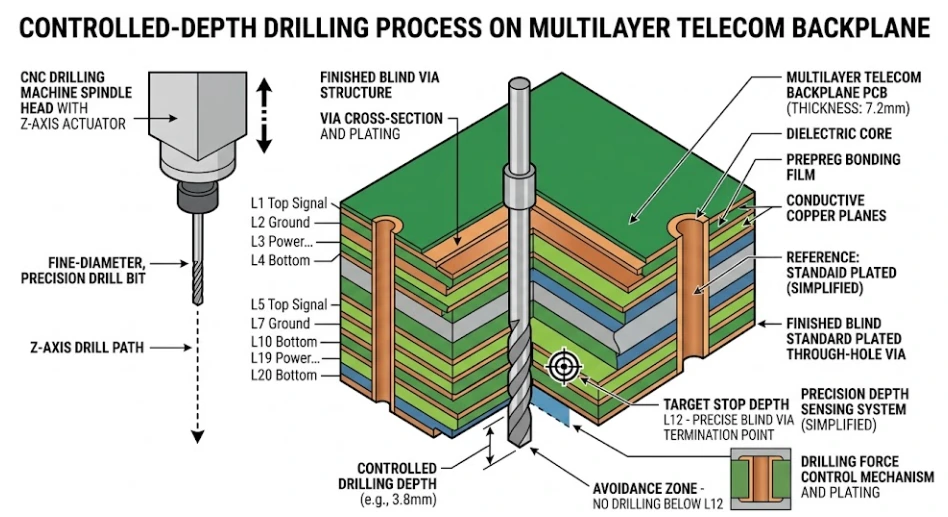
  • Backdrilling (Depth Controlled Drilling to remove Via Stubs)
  • E-Test (Verify Stub Removal)
  • Solder Mask
โ†’

Phase 2: Process Steps (Part 2)

  • Surface Finish
  • Counterbore Drilling (Depth Controlled for Screw Heads)
  • Profiling
  • FQC**
โ†’

Comprehensive Quality Assurance and Reliability Testing

To ensure the highest performance and durability of our PCBs, we implement a rigorous quality control system that adheres to IPC-A-600 Class 2 and Class 3 standards. Our testing capabilities go beyond standard connectivity checks to verify the structural integrity and long-term reliability of every batch.

  • Dimensional & Mechanical Inspection: CMM (Coordinate Measuring Machine) and Hole Gauge checks to verify outline tolerances (ยฑ0.1mm), drill diameters, and board thickness.
  • Micro-section Analysis: Cross-sectioning of finished boards to verify plating thickness (Cu/Ni/Au), hole wall quality, and dielectric spacing.
  • Solderability Testing: Simulating reflow conditions to ensure pads and holes accept solder perfectly during assembly.
  • Thermal Stress Testing: Subjecting PCBs to repeated thermal cycling (-40ยฐC to +125ยฐC) to test the reliability of vias and delamination resistance.
  • Impedance Control Testing: Using TDR (Time Domain Reflectometry) to verify that single-ended and differential impedance traces meet design specifications (typically ยฑ10% or ยฑ5%).
  • Ionic Contamination Testing: Ensuring the board surface is free of chemical residues that could cause corrosion or electromigration.

Advanced Material Inventory for Specialized Applications

We maintain a strategic inventory of high-performance materials to support the diverse needs of the automotive, telecommunications, and aerospace industries. By partnering with world-class laminate manufacturers, we ensure material consistency and availability for both prototype and mass production orders.

  • Standard & High-Tg FR4: Materials from Shengyi (S1000-2, S1170), Isola (370HR), and Kingboard (KB-6167) with Tg values ranging from 130ยฐC to 180ยฐC+.
  • High-Frequency & Low-Loss: PTFE and Ceramic-filled hydrocarbon laminates from Rogers (RO4350B, RO3003), Taconic, and Arlon for RF/Microwave applications.
  • Metal Base (IMS): High thermal conductivity Aluminum and Copper base laminates from Bergquist and Laird (1.0W/mK to 8.0W/mK) for LED and Power Electronics.
  • Flexible Materials: Polyimide (PI) films from DuPont and Panasonic for high-reliability Flex and Rigid-Flex PCBs.
  • Specialty Substrates: Halogen-free, High-CTI (Comparative Tracking Index) materials for high-voltage industrial and power supply applications.

Pre-Production Engineering and DFM Support

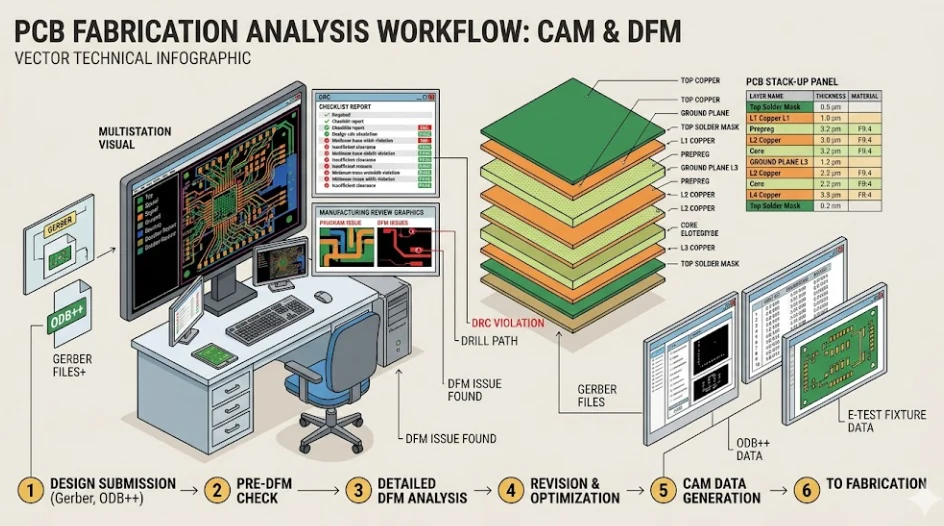
Before manufacturing begins, our experienced CAM (Computer-Aided Manufacturing) engineers perform a comprehensive Design for Manufacturing (DFM) review. This critical step minimizes production risks, improves yield rates, and reduces lead times by identifying potential design issues early in the process.

  • Data Verification: We accept Gerber RS-274X, ODB++, and DXF formats. Our system automatically checks for file integrity and layer alignment.
  • DRC (Design Rule Check): Automated scanning for minimum trace width/spacing, annular ring size, and drill-to-copper distance to ensure the design meets our manufacturing capabilities.
  • Netlist Comparison: Comparing the customer's IPC-356 netlist against the Gerber data to prevent electrical opens or shorts caused by data errors.
  • Signal Integrity Simulation: For impedance-controlled boards, we simulate the stack-up and trace geometry using Polarcale software to recommend the optimal dielectric thickness and trace width.
  • Panelization Optimization: We design efficient array layouts (V-cut or Tab-routing) to maximize material utilization and streamline your PCBA assembly process.

Need Expert Consultation for Your Custom PCB? Contact Us Today

The manufacturing processes detailed here are just a high-level overview of our capabilities. For complex designs or specialized PCB requirements, we encourage you to reach out to our team. Our experts are ready to offer in-depth consultations and design advice tailored to your specific needs, ensuring your project progresses smoothly from concept to completion.

For orders involving unique or intricate processes, early consultation can help identify and resolve potential challenges before they arise, saving you time, cost, and effort in the long run. We are dedicated to providing top-tier PCB manufacturing solutions, with robust post-production support to ensure your success every step of the way.

Frequently Asked Questions

Answers to the questions we hear most from hardware teams.

Which PCB types and processes do you support?

Single, double, multilayer, flex, rigid-flex, HDI, gold finger, ceramic, metal core, carbon ink, embedded coin, and specialized via/filling flows with detailed process steps.

How do you build HDI and via-in-pad boards?

Type I and II HDI with laser blind vias, sequential build-up, resin plugging, VIPPO/cap plating, and stacked or staggered microvias controlled across lamination cycles.

What quality and reliability tests are performed?

Dimensional checks, micro-sections for plating and dielectric, solderability, thermal stress cycling, impedance TDR, and ionic contamination testing to IPC-A-600 Class 2/3.

Which materials are available?

Standard and high-Tg FR4 (Shengyi, Isola, Kingboard), RF/low-loss (Rogers, Taconic, Arlon), metal-base IMS, polyimide flex cores, and specialty halogen-free/high-CTI substrates.

What DFM and pre-production support do you provide?

Gerber/ODB++ data verification, DRC for width/spacing and annular rings, netlist compare, impedance stack-up simulation, and panelization optimization with CAM engineer feedback.

Need expert consultation for your custom PCB?

For complex designs or specialized PCB requirements, reach out for in-depth consultations so we can guide stack-up, processes, and risk mitigation from concept to completion.