NPI small batch PCB manufacturing line

FAST CONCEPT-TO-PILOT • PRODUCTION-GRADE • DFM/DFT

NPI Small Batch PCB Manufacturing & Assembly

Validate new designs with low-quantity builds that use the same materials, stack-ups, and processes as mass production. From rigid/HDI to flex and rigid-flex, every NPI lot behaves like a scaled production run.

Get an Instant Quote

1–32+ layersLayer Count
Rigid / HDI / Flex / Rigid-flexMix
IPC Class 2/3Quality
Production-GradeStack-Ups
EmbeddedDFM/DFT
AOI/X-Ray/ICT/FCTInspection
Lot-LevelTraceability
1–32+ layersLayer Count
Rigid / HDI / Flex / Rigid-flexMix
IPC Class 2/3Quality
Production-GradeStack-Ups
EmbeddedDFM/DFT
AOI/X-Ray/ICT/FCTInspection
Lot-LevelTraceability

NPI small batch PCB manufacturing for fast concept-to-pilot transition

As electronic products move through rapid iteration cycles, NPI small batch PCB manufacturing becomes critical for validating new designs before committing to mass production. Engineering teams need production-grade boards in low quantities, with the same materials, stack-ups, and processes that will be used for volume builds. Poor alignment between prototype and production can lead to unexpected failures, redesign loops, and schedule slips once the product ramps.
Our NPI small batch PCB fabrication processes are set up to mirror high-volume production while maintaining the agility needed for fast turns. From simple 2-layer to complex multilayer, HDI, rigid, flex, and rigid-flex PCBs, we standardize on stable laminates, controlled impedance stack-ups, and tightly controlled plating and imaging processes so that every NPI lot behaves like a scaled production run.

Key NPI small batch PCB manufacturing capabilities

  • Production-Grade Stack-Ups: Standardized multilayer and HDI stack-ups with controlled impedance, matched to future mass-production configurations.
  • High-Mix Layer Support: 1–32+ layers, buried/blind vias, via-in-pad, microvias, and rigid-flex constructions for complex system designs.
  • Tight Process Controls: Controlled copper plating, line width/space, solder mask registration, and surface finishes aligned with IPC and OEM requirements.
  • Multiple Surface Finishes: ENIG, ENEPIG, HASL (lead-free), immersion tin, immersion silver, and hard gold options for different performance and cost targets.
  • Fast CAM and Tooling: Accelerated DFM review, panelization, and tooling generation optimized for low-volume, high-mix NPI small batch PCB lots.
  • Prototype-to-Pilot Consistency: Same process windows, quality criteria, and documentation applied to NPI and later production builds.

Bridging NPI prototypes to stable production

By treating NPI small batch PCB manufacturing as the first production step rather than a separate “prototype-only” process, we ensure that design assumptions, materials, and process parameters remain consistent when you scale. This reduces technical risk at ramp-up, shortens time-to-market, and gives you a reliable data foundation for yield, reliability, and cost optimization in future high-volume manufacturing.

NPI small batch PCB assembly for complex, high-mix designs

Modern electronics often combine fine-pitch digital ICs, RF front ends, power management, and mechanical interfaces on a single board. During NPI, you need to assemble these complex, high-mix PCBs in small quantities without compromising on placement accuracy, solder joint quality, or test coverage. Any assembly issue left unresolved at this stage can multiply in cost and impact once you move into larger volumes.
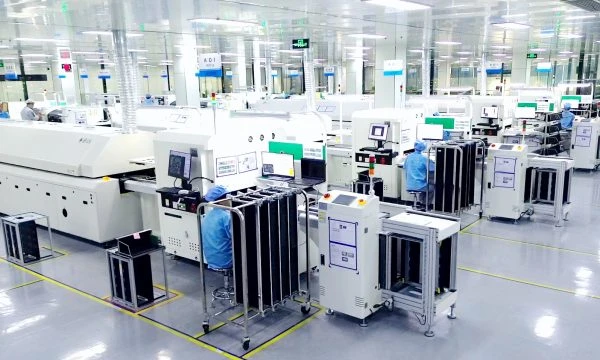
Our NPI small batch PCB assembly lines are configured for flexibility and precision. We support SMT, through-hole, and mixed-technology assemblies with fine-pitch BGAs, µBGAs, CSPs, QFNs, high-current power devices, and high-pin-count connectors, using the same automated equipment and process controls that we apply to volume production.

Key NPI small batch PCB assembly capabilities

  • High-Accuracy SMT Placement: Support for 01005/0201 passives, fine-pitch BGAs, QFNs, and CSPs on dense, high-I/O boards.
  • Mixed Technology Expertise: Seamless integration of SMT, through-hole, press-fit, and odd-form components within a single NPI small batch PCB build.
  • Optimized Stencil and Reflow Profiles: Application-specific stencil design, paste selection, and reflow profiling to minimize defects such as voiding, tombstoning, and head-in-pillow.
  • Advanced Inspection and Test: AOI, 3D AOI, X-ray for hidden joints, in-circuit test (ICT), flying probe, and functional test available even for low quantities.
  • Rapid Line Changeover: High-mix capabilities with quick program and feeder changes tailored for multiple NPI small batch PCB variants.
  • Process Documentation for Scale-Up: Capture of reflow profiles, placement programs, and test data for direct reuse in pilot and mass production.

Reliable assembly from first article to volume

By running NPI small batch PCB assemblies on production-grade lines, we expose genuine manufacturability and assembly risks early, not after release. This lets you optimize pad design, component selection, and test strategy during NPI, ensuring that your first article builds, pilot runs, and final volume manufacturing all share the same quality baseline.

DFM/DFT engineering for NPI small batch PCB projects

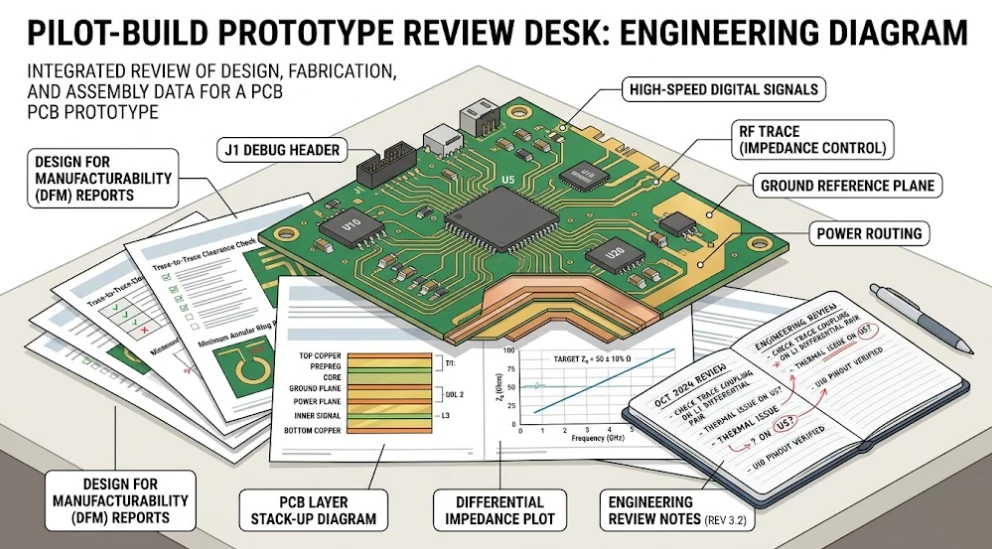
Design for Manufacturability (DFM) and Design for Test (DFT) are crucial during NPI, especially when you are working with dense layouts, tight tolerances, or new component technologies. Without structured engineering feedback at the NPI small batch PCB stage, issues such as marginal clearances, poor pad geometry, or insufficient test access can remain hidden until late in the project, when fixes are most disruptive.
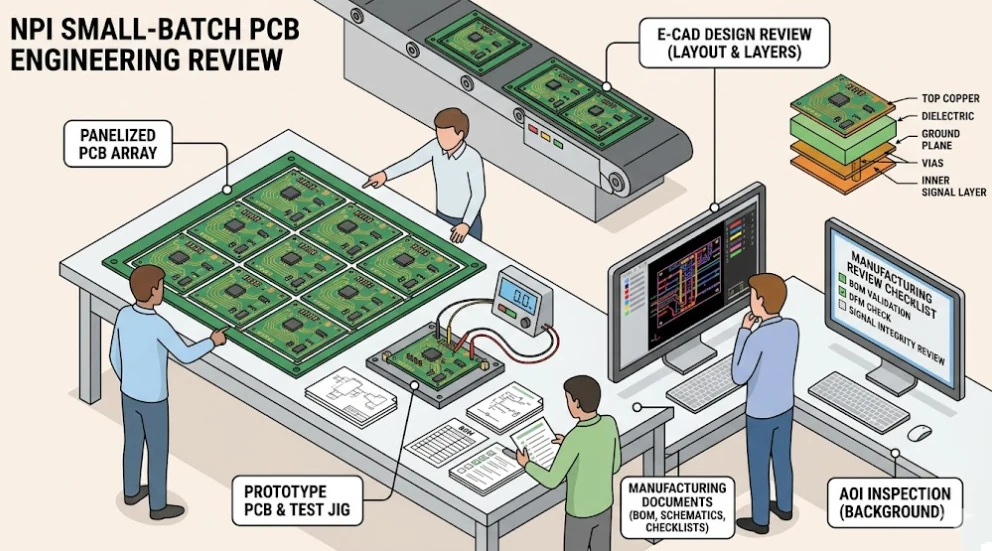
Our engineering team integrates DFM and DFT support directly into the NPI small batch PCB process. We review your Gerber/ODB++/IPC-2581 data and BOM, checking against proven process capabilities and test requirements to ensure a smooth path from design to mass manufacturing.

Key DFM/DFT services for NPI small batch PCB

  • DFM Reviews Before Fabrication: Verification of trace/space, annular rings, via structures, solder mask openings, and copper balancing against real process limits.
  • Assembly-Oriented Layout Checks: Analysis of component spacing, orientation, fiducial placement, and panelization for robust NPI small batch PCB assembly.
  • Test Strategy Definition: Guidance on test point allocation, boundary scan, ICT, flying probe, and functional test strategies even for small lots.
  • Signal Integrity and Power Integrity Considerations: Suggestions for stack-up optimization, return path integrity, decoupling distribution, and controlled impedance routing.
  • Thermal and Mechanical Considerations: Recommendations for heat spreading, copper pours, keep-out regions, and mechanical reinforcement for connectors and heavy components.
  • Closed-Loop Feedback into Next Revision: Detailed build reports and defect analysis to inform layout changes before committing to qualification and volume.

Lower Risk and Higher Yield from the First Build

By embedding DFM and DFT into every NPI small batch PCB build, we help you avoid late-stage surprises, reduce re-spin cycles, and improve first-pass yield. The result is a more manufacturable design, a well-defined test strategy, and a smoother transition from engineering validation to full-scale production.

Production-grade materials, stack-ups, and processes in NPI

The materials and stack-up choices made at the NPI stage have a direct impact on electrical performance, reliability, and cost in volume production. If prototypes are built on “prototype-only” material sets, you may see different behavior when the design is migrated to standard production laminates or finishes. For high-speed, RF, automotive, medical, and industrial applications, this mismatch can be unacceptable.
In our NPI small batch PCB manufacturing, we prioritize using production-intent materials, controlled stack-ups, and stable processes from the very beginning. This ensures that performance and reliability metrics measured during validation accurately reflect what you will see later in mass production.

Key process and material controls for NPI small batch PCB

  • Standardized Material Platforms: FR-4, high-Tg, halogen-free, high-speed/low-loss, RF, and high-thermal laminates aligned with volume production availability.
  • Controlled Impedance Stack-Ups: Predefined stack-up libraries with verified impedance models and tolerances for differential pairs and single-ended high-speed signals.
  • Thermal Performance Optimization: Copper weight selection, via structures (thermal vias, via arrays), and thermal relief design tuned for real operating conditions.
  • Reliability-Focused Processes: Controlled lamination cycles, resin flow, and void management to support demanding automotive, industrial, and medical standards.
  • Surface Finish Selection by Application: Guidance on ENEPIG, ENIG, or other finishes based on wire bonding, fine-pitch, or high-frequency requirements.
  • IPC and Customer-Specific Standards: NPI small batch PCB builds aligned with IPC-A-600, IPC-A-610, and any required customer-specific qualifications.

Consistent performance from validation to field deployment

By building NPI small batch PCB lots on the same material and process platforms used for mass production, you gain confidence that your validation test results—signal integrity, thermal behavior, EMC, and reliability—will hold in the field. This reduces technical risk, accelerates regulatory approvals, and simplifies the path to long-term, stable supply.

Flexible capacity: From NPI small batch to medium/high volume

Many products start with a handful of engineering validation units and quickly move to pilot runs, regional launches, and then global volume. Choosing a partner that can handle both NPI small batch PCB builds and large-scale mass production eliminates handovers, requalification, and communication gaps between different factories.
Our manufacturing footprint is designed to follow your product through each phase of its lifecycle. We can repeat NPI small batch PCB orders for ongoing engineering changes or niche variants, while also supporting ramp-up to tens of thousands of boards per month on dedicated production lines.

Scaling path from NPI small batch PCB to volume

  • Structured Ramp Plans: Clear transition steps from EVT/DVT (engineering and design validation) to PVT (production validation) and full-scale production.
  • Line and Process Replication: Transfer of validated NPI process parameters, tooling, and test programs into high-volume lines without re-engineering.
  • Panel and Yield Optimization: Data-driven panelization and process tuning informed by early NPI yield and defect analysis.
  • Capacity Planning and Buffering: Flexible capacity allocation to support demand peaks, regional programs, and multiple product generations.
  • Configuration and Variant Management: Support for multiple PCB revisions, options, and configurations throughout the product lifecycle.
  • Cost Optimization at Scale: Continuous improvement programs and sourcing optimization as volume increases and the design stabilizes.

One manufacturing partner from first build to mature product

With a single partner responsible for NPI small batch PCB manufacturing and volume production, you avoid duplicated effort, inconsistent quality standards, and communication gaps. This integrated model shortens ramp time, stabilizes yield, and gives you predictable cost and delivery performance as your product matures.

Supply chain control, quality, and traceability for NPI and beyond

Even at low quantities, NPI projects demand stable supply chains and robust quality control. Component obsolescence, allocation, and inconsistent incoming quality can cause build delays or functional issues that undermine your schedule. Without proper traceability, it becomes difficult to pinpoint root causes or correlate field returns with specific builds, lots, or design revisions.
Our NPI small batch PCB service integrates supply chain management, quality assurance, and traceability from the first build. We coordinate PCB fabrication, component procurement, and assembly under unified control, applying the same quality systems used for high-volume manufacturing.

Key supply chain and quality features for NPI small batch PCB

  • Integrated Turnkey Procurement: Centralized sourcing and qualification of bare boards, components, and mechanical parts to avoid fragmented responsibility.
  • BOM Risk Analysis: Early assessment of lifecycle status, alternates, and supply risk for critical components before mass production.
  • Incoming and In-Process Quality Control: Controlled incoming inspection, process audits, AOI/X-ray, and final electrical/functional testing for every NPI batch.
  • Lot-Level Traceability: Board-level serialization, date codes, and lot tracking for key materials and components.
  • Data Collection and Reporting: Build reports, SPC data, defect Pareto charts, and test summaries available for engineering review and qualification.
  • Scalable Traceability Model: The same traceability structure can be extended and deepened as production volumes and regulatory requirements increase.

Confidence from first articles to long-term supply

By embedding supply chain discipline, quality control, and traceability from the first build, we de-risk launch and build a foundation for global production—clear visibility, rapid response to changes, and stable, repeatable volume.

Get an NPI small batch PCB quote

Share your Gerber/ODB++, BOM, and build targets. We’ll return a coordinated engineering review and proposal tuned to your volume, cost, and quality goals.

Need production-grade NPI small batch PCBs?

Upload files and requirements—we’ll return feasibility, DFM/DFT notes, schedules, and pricing aligned to your ramp plan.

Frequently Asked Questions

Answers to the questions we hear most from hardware teams.

What technologies and layers do you support for NPI small batch PCBs?

Rigid, HDI, flex, and rigid-flex from 1–32+ layers with buried/blind vias, via-in-pad, microvias, and controlled impedance stack-ups.

Which surface finishes are available?

ENIG, ENEPIG, lead-free HASL, immersion tin/silver, and hard gold, selected to match performance and cost targets.

How do you ensure NPI results match mass production?

Production-intent materials, controlled stack-ups, and stable processes ensure validation behavior mirrors volume builds.

What inspection and test options are offered?

AOI/3D AOI, X-ray, ICT, flying probe, and functional testing are available for small-lot NPI builds.

How do you manage supply chain risk during NPI?

Turnkey procurement, BOM risk analysis, lot-level traceability, and scalable quality/traceability controls de-risk launch and scale.

Need production-grade NPI small batch PCBs?

Upload files and requirements—we’ll return feasibility, DFM/DFT notes, schedules, and pricing aligned to your ramp plan.