Material Selection Guide
How to Choose the Right Arlon Material for Your Design
The optimal Arlon laminate depends entirely on your primary environmental or electrical constraint: extreme heat, extreme power, dimensional stability, or ultra-low loss. Here is a practical selection framework based on our manufacturing experience with high-Tg PCB and RF builds.
Extreme Heat & Avionics (MOT > 150°C) — 33N / 85N Polyimide
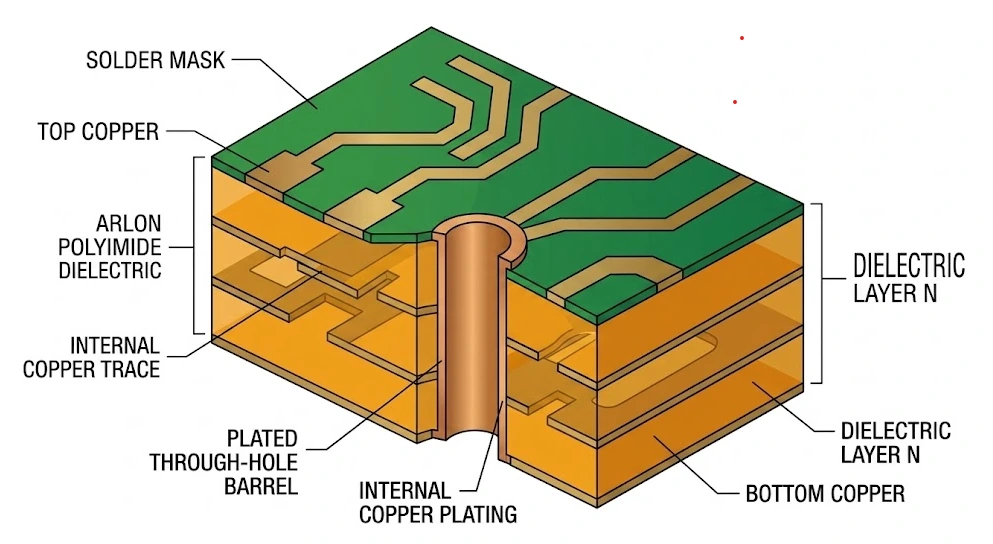
If your PCB will be placed inside a jet engine compartment, used in deep oil-well drilling equipment, or serve as a semiconductor burn-in board undergoing repeated 200°C+ thermal cycles, standard FR-4 will delaminate and fail. Arlon 33N (and the premium 85N) polyimide is required. It features a Tg > 250°C and maintains structural integrity in environments where other plastics melt or soften.
High-Power RF & Thermal Management — TC350
For RF power amplifiers and tower-mounted amplifiers where active GaN components generate intense, concentrated heat, the substrate must act as a heat spreader. Arlon TC350 is specifically engineered for this, offering 1.0 W/m·K thermal conductivity while maintaining a microwave-friendly Dk of 3.50.
Microwave & Phased Arrays (Phase Stability) — CLTE-XT / CLTE-MW
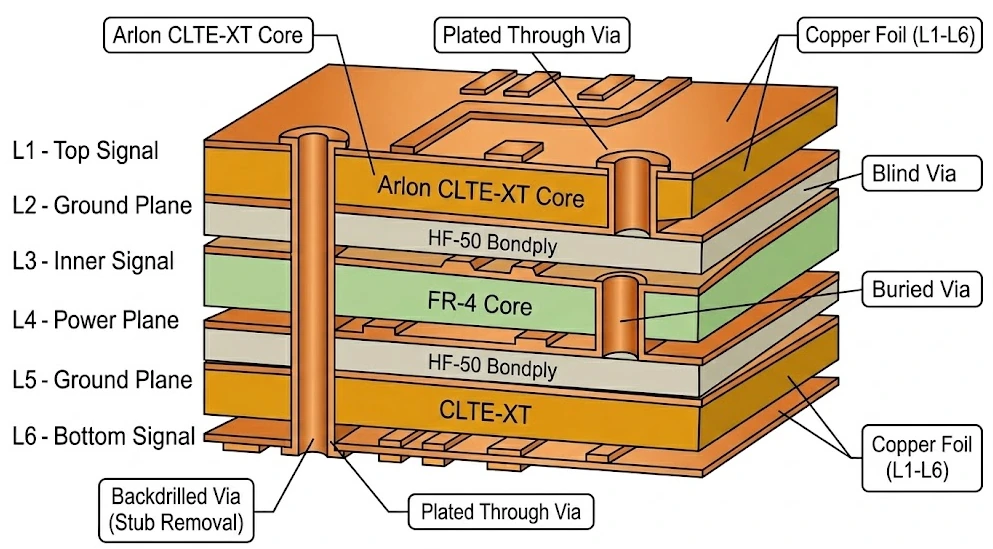
For phased-array radar, satellite communications, and military RF where phase stability across temperature is critical, CLTE-XT is the benchmark. It is a PTFE material loaded with ceramic to closely match the X, Y, and Z-axis CTE of copper, producing reliable plated through-holes in complex high-layer-count RF boards.
Bare Die / LCC Packaging (Low CTE) — Thermount 55NT
When mounting large ceramic Leadless Chip Carriers directly to a PCB, the standard thermal expansion of glass-reinforced FR-4 will shear the solder joints as the board heats up. Thermount 55NT uses non-woven aramid fibers instead of glass, restricting in-plane expansion to better match the ceramic package while remaining significantly lighter than standard polyimide.
Cost-Effective High-Reliability — 45N Epoxy
If your design needs military-grade reliability and high layer counts but does not quite reach the extreme temperatures that mandate polyimide, Arlon 45N and 47N multifunctional epoxy are the ideal middle ground. They offer excellent CAF resistance, survive lead-free reflow easily, and are much cheaper and easier to process than pure polyimide.