PCB depaneling and profiling with CNC routing, V-score, and laser singulation

Precision Singulation

PCB Depaneling & Profiling - CNC, V-Score & Laser

Board singulation is the final manufacturing step that determines dimensional accuracy, edge quality, and compatibility with automated assembly lines. APTPCB offers every PCB depaneling method on one production platform: CNC routing for complex outlines, V-score (V-cut) for maximum panel utilization, tab routing with mouse-bite for non-rectangular assemblies, laser depaneling for stress-free flex singulation, and edge plating for castellated module designs. Every method is calibrated per substrate - FR-4, polyimide, PTFE, MCPCB - with ±0.1 mm dimensional accuracy and delamination-free edges.

±0.1 mm
Dimensional Accuracy
5 Methods
CNC · V-Score · Laser
18 × 24 in
Max Panel Size

Get an Instant Quote

CNC RoutingComplex Outlines
V-Score / V-CutStraight Edges
Tab + Mouse-BiteBreakaway Panel
Laser DepanelStress-Free
Edge PlatingCastellation
±0.1 mmBoard Outline Tol.
Chamfer / BevelGold Finger Edge
Internal CutoutsMin. 1.0 mm Width
CNC RoutingComplex Outlines
V-Score / V-CutStraight Edges
Tab + Mouse-BiteBreakaway Panel
Laser DepanelStress-Free
Edge PlatingCastellation
±0.1 mmBoard Outline Tol.
Chamfer / BevelGold Finger Edge
Internal CutoutsMin. 1.0 mm Width

Full-Spectrum Singulation

Every PCB Depaneling Method on One Production Platform

As a full-capability PCB depaneling and profiling manufacturer, APTPCB handles every board singulation method under one roof - eliminating the fragmentation that forces teams to split fabrication, panelization design, and depaneling across multiple vendors. From Silicon Valley hardware startups requiring tight-tolerance CNC routing for wearable and IoT board outlines to European automotive Tier-1 suppliers running high-volume V-score panel arrays through automated singulation cells, we match the depaneling process to your exact geometry, material, and assembly workflow.

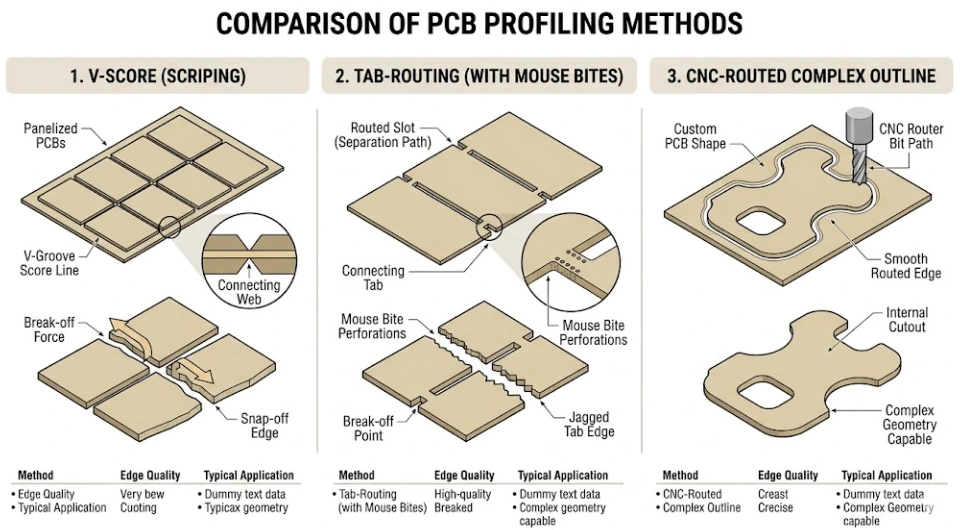
Our Schmoll and LPKF high-speed CNC routers handle complex PCB shapes - curves, castellated edges, beveled gold-finger contacts, and internal cutouts - at ±0.1 mm accuracy. The automated V-score (V-cut) line delivers straight-edge board separation with 0.3-0.5 mm residual web control. Tab routing with mouse-bite perforations (stamp-hole breakaway) enables any board geometry within a panel array with clean manual or automated breakaway. For sensitive flex, rigid-flex, and thin (<0.8 mm) boards where mechanical stress risks solder-joint cracking or ceramic capacitor damage, our UV laser depaneling system provides zero-stress singulation at ±0.05 mm accuracy - no tooling contact, no vibration, no mechanical flexure.

The depaneling decision is closely tied to fabrication flow, slot and cutout processing, and post-SMT handling. That is why we review panelization, breakaway strategy, and edge treatment together during DFM instead of treating profiling as an afterthought.

Panel array showing multiple PCB depaneling methods on one production platform

Method Selection Guide

Which PCB Depaneling Method Is Right for Your Design?

The optimal board singulation method depends on board geometry, material, assembly method, production volume, and edge quality requirements. Use this guide to select the correct approach before finalizing your panel design.

CNC Routing

±0.1 mm
Dimensional accuracy

Best for complex outlines, curves, notches, and internal cutouts. Any board shape. Edge quality is smooth and clean. Requires a routing kerf (1.6–2.4 mm gap between boards), reducing panel utilization vs. V-score.

Any shapeInternal cutoutsComplex geometry
Highest utilization

V-Score (V-Cut)

±0.1 mm
Scoring position

Best for rectangular boards in high-volume arrays. No routing kerf = maximum panel utilization and lowest material cost. Straight-line separation only. Rough breakaway edge. Requires ≥0.5 mm component clearance from score line.

Rectangular onlyMax utilizationHigh volume

Tab Routing (Mouse-Bite)

±0.1 mm
Dimensional accuracy

Best for non-rectangular boards that still need panel retention during SMT assembly. Any outline shape. Boards held in panel by 2.0-3.0 mm tabs with closely spaced 0.5-0.6 mm non-plated holes. Small tab remnant at breakaway points.

Any shapePanel retentionSMT compatible

Laser Depaneling

±0.05 mm
Best-in-class precision

Zero mechanical stress — no tooling contact, no vibration. Required for flex PCBs, thin boards (<0.8 mm), and boards with components ≤0.1 mm from the edge. UV laser produces smooth, burr-free edges. Higher cycle time and cost than mechanical methods.

Flex / rigid-flexThin boardsZero-stress

Design Rule: Component-to-Edge Clearance by Method

CNC routing: ≥0.3 mm clearance from routed edge. V-score: ≥0.5 mm from groove center (mechanical stress during breakaway extends into this zone). Tab routing: clearance required only at tab locations. Laser depaneling: ≥0.1 mm - the tightest of any method. Specify your depaneling method in Gerber/fab notes so DFM review can verify component placement before production.

Specifications

PCB Profiling & Depaneling Specifications

Complete capability specifications for all PCB profiling, depaneling, and specialty edge treatment processes.

MethodAccuracyEdge QualityBoard ShapesMin. Comp. ClearanceBest Application
CNC Routing±0.1 mmSmooth, cleanAny shape, curves, cutouts≥0.3 mmComplex outlines, individual boards, PTFE/Rogers substrates
V-Score / V-Cut±0.1 mm positionRough breakaway edgeStraight lines only≥0.5 mmRectangular arrays, maximum panel utilization
Tab Routing + Mouse-Bite±0.1 mmSmall tab remnantAny shape + panel retention≥0.3 mm (non-tab areas)Non-rectangular boards, SMT assembly arrays
Laser Depaneling (UV)±0.05 mmExcellent, burr-freeAny shape, thin materials≥0.1 mmFlex, rigid-flex, thin boards, component-close edges
Punch / Die Cut±0.1 mmClean cutSimple outlines≥0.3 mmHigh-volume flex PCB singulation
Specialty Edge TreatmentSpecificationNotes & Application
Edge Plating (Castellation)Plated half-holes, 0.5–1.2 mm diameterModule-to-motherboard solder mounting. Plating performed before routing so cut exposes the castellated wall.
Gold Finger Beveling20° or 30° bevel, controlled depthCard-edge connector insertion. Beveled after hard gold plating; depth removes 30–50% of edge thickness.
Chamfering45° edge break, 0.3–0.5 mmDeburring for safe handling; not for connector contact areas.
Internal CutoutsMin. 1.0 mm width, internal corner radius ≥ bit radius (0.5–1.2 mm)Connector clearance, airflow, mechanical integration features.
Plated SlotsMin. 0.6 mm width, copper-plated wallsBlade connectors, USB, high-current terminals. Drilled and plated before routing.
Depth-Controlled Milling±0.1 mm depth accuracyComponent cavities, embedded coin pockets, flex-zone thickness reduction.
V-Score Residual Web0.3-0.5 mm ±0.1 mmControls breakaway force. Thinner = easier break; thicker = more panel rigidity during assembly.
Mouse-Bite Holes0.5–0.6 mm dia., 0.75–1.0 mm pitchNon-plated breakaway perforations in tab routing. Pitch controls breakaway force.

Panel dimensions: max 18 × 24 inches (457 × 610 mm). Minimum board dimension: 5 mm on any side for CNC routing. V-score available for board thicknesses 0.4-3.2 mm. Laser depaneling optimal for boards ≤1.6 mm thick.

Advanced Capabilities

Advanced PCB Profiling Processes & Specialty Edge Treatments

Beyond standard board outline cutting, these specialized processes create unique edge features for module integration, connector systems, and challenging board geometries.

01

Castellation & Edge Plating for Modules

Castellated PCBs use copper-plated half-holes along the board edge to create solder pads for direct surface-mount attachment to a motherboard - making the module act as a large SMT component. The process requires drilling full through-holes along the intended board edge, plating them with copper using the same electrolytic bath as PTH vias, and then routing through the hole centerline during final profiling to expose the half-moon castellation. We fabricate Wi-Fi modules (ESP32, nRF52 series form factors), Bluetooth LE modules, LoRa concentrators, GPS/GNSS modules, and power management modules to castellated specifications. Edge plating also provides continuous perimeter ground continuity for RF shielding applications where an unbroken conductive edge is required.

02

Gold Finger Beveling for Card-Edge Connectors

PCIe, PCI, DDR, M.2, and SODIMM card-edge connectors require a beveled insertion edge to guide the board smoothly into the slot without damaging the gold-plated contact fingers or the ZIF (zero insertion force) connector mechanism. We bevel card-edge insertion contacts at 20° (standard) or 30° (deeper chamfer for stiff connectors) using precision beveling machines that control angle, depth, and finish across the full finger array width. Beveling is always performed after hard gold plating (typically 30 µin / 0.75 µm) to ensure gold coverage extends to the bevel face. Bevel depth is controlled to remove 30–50% of the board thickness at the edge, with uniformity verified across the entire connector tab width.

03

Laser Depaneling - Stress-Free Board Singulation

LPKF UV laser depaneling uses a focused 355 nm laser beam to ablate board material without mechanical contact, eliminating the vibration and flexure forces that CNC routing imposes on assembled boards. This zero-stress separation is critical for: flex and rigid-flex PCBs where routing stress delaminate the PI-copper interface near the rigid-to-flex boundary; boards with multilayer ceramic capacitors (MLCCs) close to the board edge where mechanical vibration causes micro-fractures that fail in the field; ultra-thin boards (< 0.8 mm) where routing chatter causes warpage; and any design where components are placed closer than 0.3 mm to the board edge. Laser depaneling achieves ±0.05 mm dimensional accuracy - two times tighter than CNC routing - with smooth, burr-free, carbonization-minimized edges from the optimized UV wavelength.

04

Internal Cutouts & Plated Slots

Internal cutouts are created by CNC plunge routing - the spindle enters the panel interior and cuts the required window shape. Minimum internal cutout width is 1.0 mm (limited by router bit diameter). Internal corners have a minimum radius equal to the bit radius (0.5-1.2 mm); sharper corners require sequential multi-pass approaches. Plated internal slots (used for USB-A, blade connectors, and high-current terminal strips) require drilling the slot outline to create platable surfaces before routing - the slot is drilled as a chain of overlapping holes, plated, then the walls routed to final dimension, leaving copper-plated walls. This sequence ensures complete copper coverage on all four slot walls for reliable connector termination and current carrying capacity.

05

Depth-Controlled Milling for Embedded Components

Controlled-depth pocket milling creates cavities within the board area for embedded passive components, copper coin inserts, or mechanical integration features. Pocket depth accuracy is ±0.1 mm, maintained across multi-pass milling strategies that prevent thermal distortion from single-pass aggressive cuts. For embedded copper coin thermal management applications, the coin cavity is milled to a tight dimensional tolerance to ensure flush seating during lamination - incorrect pocket depth results in uneven pressure during lamination and voiding at the coin-dielectric interface. Pocket milling is also used to create localized board thickness reductions at flex hinge zones in otherwise rigid boards, enabling controlled bend radii without requiring full rigid-flex construction.

06

Material-Specific Routing Parameters

Each PCB substrate material demands specific tooling and routing parameters to produce clean, delamination-free edges. Standard FR-4 routes cleanly with carbide end mills at standard spindle speeds and feed rates optimized for the specific Tg and thickness. Rogers PTFE laminates (RT/duroid, RO3000 series) require significantly reduced feed rates and specialized entry/exit sequences — the soft PTFE matrix deforms rather than cuts cleanly at standard parameters, producing jagged edges and delamination between PTFE and copper layers at the cut face. Aluminum and copper MCPCB substrates require diamond-coated or TiAlN-coated carbide tools, controlled coolant application, and deburring sequences to prevent metal smearing at the metal-dielectric interface. Rigid-flex boards require careful routing sequence at the rigid-to-flex boundary and often benefit from laser depaneling at sensitive flex transition zones. Our production database contains validated routing programs for every substrate type we process.

Panel Design

PCB Panelization Design — Assembly Compatibility & Cost Optimization

Panelization — the arrangement of individual PCB units within the production manufacturing panel — is a cost and quality engineering decision that affects material utilization, assembly line compatibility, depaneling method constraints, and inspection access. Panel design should be finalized during the fabrication quoting stage, not after assembly tooling is ordered.

Assembly Line Compatibility Requirements
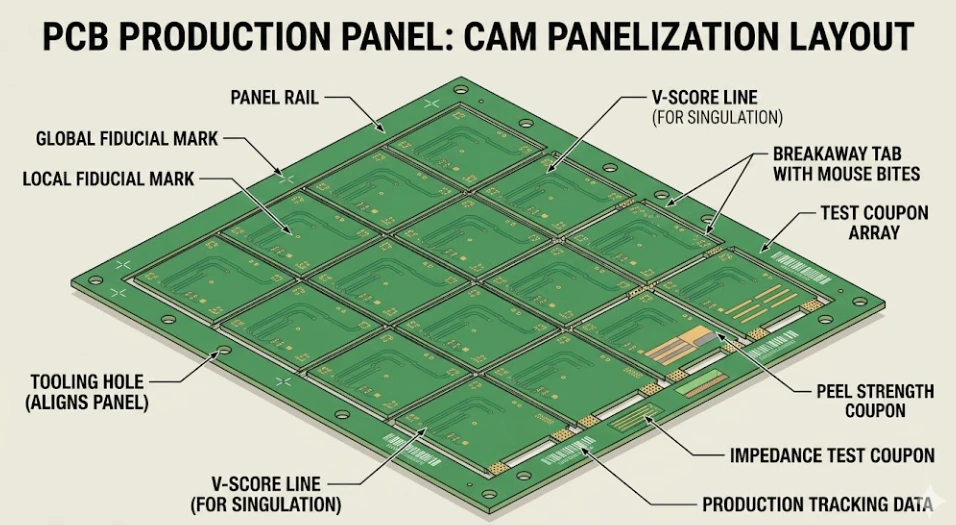
SMT assembly conveyors handle panels in standard width ranges (50–330 mm typical) with 5 mm minimum rails on each conveyor edge for clamping. Panel rails must include: at least three global fiducials per panel (copper targets, typically 1.0 mm diameter, with 5 mm no-copper keepout) for pick-and-place machine vision alignment; tooling holes at rail corners for fixture registration; lot identification marking (date code, lot number, panel serial); UL marking if required; and impedance test coupons for controlled-impedance builds. Board-to-rail clearance of ≥5 mm prevents conveyor clamps from interfering with components near board edges.

Panel Utilization & Array Optimization
Our standard 18 × 24 inch (457 × 610 mm) production panels accommodate various array configurations. For V-score panels, boards pack edge-to-edge with no gap — maximizing utilization. For CNC-routed panels, the routing kerf (1.6–2.4 mm router bit diameter) removes material between boards, reducing utilization 5–15% vs. V-score. Rotating board orientation 90° in the array sometimes increases board-per-panel count by 10–20% — our CAM engineers evaluate both orientations during panelization design. Boards within ±1–2 mm of standard fractions of panel dimensions (e.g., a 50 × 50 mm board fits exactly 8 per row on a 457 mm panel) can substantially improve utilization.

Mouse-Bite (Stamp-Hole) Design Rules
Tab routing with mouse-bite perforations uses 2.0–3.0 mm wide connection tabs between board and panel rail, with 0.5–0.6 mm diameter non-plated holes spaced 0.75–1.0 mm apart along the breakaway line. Tab count and placement should be symmetric around the board to prevent panel bowing. Minimum tab count for boards under 50 mm: 2 tabs per side. Boards over 100 mm: 3–4 tabs per side minimum. The breakaway force is controlled by adjusting hole spacing — closer holes reduce force, wider spacing increases it. For automated inline depaneling, specify the required breakaway force range and we design the tab geometry accordingly.

CAM panelization layout with depaneling method constraints and assembly rails

Industry Applications

PCB Depaneling Requirements Across Industries

Different industries place specific and often conflicting demands on PCB profiling — from high-volume SMT panel arrays to precision-tolerance complex shapes with castellation and internal cutouts.

Consumer Electronics

High-Volume V-Score & Laser Arrays

V-score panels for maximum material utilization on high-volume rectangular board production runs. Optimized SMT arrays with fiducials, tooling holes, and conveyor-compatible rail dimensions for automated assembly lines. UV laser depaneling for ultra-thin smartphone mainboards (≤0.8 mm) and flex circuit singulation where mechanical stress would crack ceramic decoupling capacitors soldered within 0.2 mm of the board edge.

Wireless & IoT Modules

Castellated Edge Plating

Castellated half-hole edge plating on Wi-Fi (ESP32, Mediatek MT7682), Bluetooth 5.x (nRF52840), LoRa, and GPS/GNSS modules for direct SMT solder mounting to motherboards - eliminating SMT pin headers and reducing module height. Edge plating also provides unbroken perimeter ground continuity for RF shielding on modules requiring FCC/CE radiated emission compliance. CNC routing of complex module outlines with antenna clearance windows and RF keepout shapes.

Server & Backplane

Gold Finger Beveling

Precision 20° or 30° gold finger beveling on card-edge connector tabs for PCIe Gen4/5 add-in cards, DDR5 DIMM modules, M.2 NVMe SSDs, and server backplane plug-in line cards. Bevel quality directly affects insertion force, connector wear life, and impedance continuity at the gold-finger contact interface — critical for high-speed differential pairs at 32 Gbps+ per lane. Gold hard-plated at 30 µin before beveling ensures complete gold coverage on the bevel face.

Automotive Electronics

Precision Housing-Fit Routing

CNC routing to ±0.1 mm dimensional tolerance for automotive ECU boards that must seat precisely within injection-molded plastic housings with controlled interference fits at mounting bosses. Tab routing with defined breakaway force for automated inline depaneling on automotive SMT lines running at high throughput. Edge chamfering for safe handling during manual assembly. IATF 16949 documentation and SPC dimensional tracking available for automotive supplier qualification.

Aerospace & Defense

Complex Shapes & MIL-Spec Edges

Complex board outlines with internal cutouts for connector access windows, cooling airflow channels, and mechanical bracket integration in avionics LRU chassis. Depth-controlled milling for embedded component cavities in high-density defense electronics. Laser depaneling for rigid-flex assemblies in space-constrained installations where mechanical stress could damage PI-copper adhesion at rigid-to-flex transitions. IPC-A-600 Class 3 edge quality documentation available.

LED Luminaires & Power

MCPCB Routing & V-Score

Specialized CNC routing for aluminum-base (Al-MCPCB) and copper-base LED boards using TiAlN-coated carbide tooling optimized to prevent aluminum galling, metal burrs, and smearing at the metal-dielectric interface. V-score of MCPCB arrays for high-volume LED panel production — aluminum V-scoring requires blade geometry and depth calibration specific to the metal base thickness and dielectric layer properties. Clean metal edges without protrusions that would prevent board seating in LED luminaire housings.

Design Guidelines

PCB Profiling & Panelization Design Guidelines

Board Outline Geometry for Maximum Panelization Efficiency

Design board outlines to optimize panelization efficiency on the production panel. Rectangular boards with dimensions that are whole-number fractions of 457 mm (18 in) or 610 mm (24 in) fit the most efficiently - for example, a 50 × 50 mm board yields a 9 × 12 = 108 board array per panel with V-scoring, while a 52 × 52 mm board yields only 8 × 11 = 88 boards (18% fewer). When design flexibility permits, consult our CAM engineers about board outline dimensions before committing to a footprint that yields poor panelization efficiency. Non-rectangular boards (L-shaped, T-shaped, contoured) should use tab routing and may be interlocked in alternating orientations to reduce wasted panel area between irregular shapes.

Specifying Profiling Method in Fabrication Data

Include all profiling requirements in your fabrication documentation: the board outline on a dedicated mechanical layer (Gerber RS-274X or IPC-2581), profiling method (CNC/V-score/tab/laser), internal cutout dimensions and positions, edge plating/castellation hole diameter and locations, gold finger tab dimensions and bevel angle, panel array preferences (board quantity, orientation, rail width), and any automated depaneling compatibility requirements (conveyor width limits, breakaway force range, depaneling machine model if known). Insufficient profiling documentation is the most common cause of DFM feedback requiring customer input before production can start.

V-Score vs. Tab Routing - The Decision Matrix

Choose V-score when: boards are rectangular or very nearly rectangular (minor irregular features can be CNC-routed after panel breakaway); production volumes justify the higher per-panel board count; edge cosmetics after separation are not critical (the V-score breakaway edge is rough and shows the glass weave); and all components maintain ≥0.5 mm clearance from the score line. Choose tab routing when: boards are non-rectangular; a clean edge is required on all sides before assembly; components are within 0.5 mm of any edge; or the panel must survive multiple SMT reflow passes before singulation without V-score pre-breaking. Many designs benefit from combining methods - V-score on the long sides (straight) and tab routing on the short sides (where connectors create irregular profiles).

Profiling-related design decisions must be made early — board outline geometry, component placement near edges, connector locations, and panelization method interact with each other and must be consistent before layout is completed. Late changes to profiling method require re-running DFM and potentially re-placing edge-adjacent components.

Automated Post-Assembly Depaneling Considerations

Manual vs. Automated Depaneling

Manual breakaway (operator flexes panel along V-score or snaps tab connections) is suitable for low-volume production (<500 boards/month) where cycle time and automation investment are not justified. Consistency depends on operator technique - training is required to prevent board flexure that exceeds the elastic limit of solder joints. Pizza-cutter blade machines (circular rotary blade running along V-score groove) provide faster, more consistent V-score panel separation at medium volumes with less operator variability. Automated inline depaneling routers (CNC routing after assembly) provide the highest edge quality and most consistent dimensional results, and are required for high-reliability automotive, medical, and aerospace assemblies. Laser depaneling post-assembly represents the highest quality tier - no mechanical contact, no stress transmission to any assembled component regardless of proximity to the singulation line.

Fiducial Mark Requirements for Post-Assembly Depaneling

Post-assembly depaneling routers require fiducial marks for optical alignment - without them, the depaneling program cannot correct for the small positional variation between individual boards within the panel (typically ±0.2-0.5 mm accumulated from the lamination, imaging, and routing processes). Place local fiducials at two diagonally opposite corners of each board - 1.0 mm copper circle targets with 3 mm copper-free keepout - and global fiducials at all four corners of the panel rail. The automated depaneling machine performs a 2-point or 3-point correction from the fiducials before executing the singulation program, compensating for any offset or rotation variation in the assembled panel's position on the depaneling fixture.

When the board will be assembled in panel form and singulated after SMT soldering and inspection, the post-assembly depaneling method must be selected during panel design — not after. The depaneling stress profile directly affects solder joint reliability and component damage risk, which is especially relevant for ceramic capacitors (MLCCs), fine-pitch BGAs, and QFN packages placed close to panel break lines.

PCB Profiling Quality Standards

Profiling quality is verified against IPC-A-600 acceptance criteria for the specified class (Class 2 standard commercial; Class 3 high-reliability). Key inspection criteria: no delamination at the cut edge exceeding 50% of the conductor-to-edge clearance; no glass fiber pull-out exceeding 0.13 mm; no copper exposure or overhang at routed edges; V-score residual web thickness within ±0.1 mm of specified value; and board outline dimensional compliance within ±0.1 mm of the mechanical drawing for CNC-routed edges. First-article measurement is performed on optical measurement systems or CMM before production release. Production SPC tracks key dimensions with tool-wear-triggered router bit replacement to maintain tolerance throughout the production run.

Material-Specific Routing

PCB Routing Parameters by Substrate Material

Each substrate type requires dedicated routing parameters — tooling grade, spindle speed, feed rate, and edge treatment — to produce clean, delamination-free cut faces.

SubstrateKey Routing ChallengeAPTPCB Process SolutionEdge Result
Standard FR-4 (Tg 130–150)Glass fiber pull-out at high feed rates; delamination on thick panels (>3.2 mm)Optimized feed/speed ratio per thickness; carbide upcut/downcut spiral bits for clean both-face edgeSmooth, clean cut, minimal glass protrusion
High-Tg FR-4 (>170°C)Harder, more abrasive resin system accelerates bit wear; edge cracking risk in brittle formulationsPremium sub-micron carbide tooling; reduced bit-life intervals; dust extraction prevents thermal redepositionClean edge, consistent across lot with monitored tool wear
Rogers RO4350B / RO3003 (PTFE)Soft PTFE matrix deforms and smears at standard speeds; PTFE-copper delamination at cut faceReduced spindle speed and feed rate; controlled entry/exit angles; no coolant (coolant contaminates PTFE pores)No PTFE delamination; copper overhang at routed face within IPC-A-600 limits
Taconic TLY / RT/duroid 5880Very soft pure PTFE; highest delamination risk of all substrates; glass microfiber reinforcement frays easilyMinimal feed rate, sharp tooling replaced at short intervals; laser depaneling recommended for critical edge requirementsAcceptable with CNC; laser preferred for tight component-to-edge clearance
Aluminum MCPCBMetal burrs at aluminum-dielectric boundary; aluminum loading on cutting edge; heat generation causing resin smearTiAlN-coated carbide cutters; controlled air coolant; inline deburring with abrasive brush after routingBurr-free aluminum and dielectric edges; no smearing at interface
Copper MCPCBCopper galling on cutter flutes at standard conditions; heat buildup causes localized dielectric smear adjacent to copper baseDiamond-coated tooling or PCD (polycrystalline diamond) cutters; controlled coolant flow rate to prevent thermal damageClean copper edge without galling artifacts; dielectric fully attached
Polyimide Flex (PI)Thin PI film tears and stretches rather than cutting cleanly; stacking flex panels increases heat at cut faceLaser cut (preferred) or precision low-speed routing with very sharp tooling; foam backing board prevents flex lift during routingLaser: clean, no tearing. CNC: acceptable with sharp tooling and low feed rate
Rigid-Flex (Rigid + PI transition)Delamination risk at rigid-to-flex boundary; adhesive smear in PI section; flex section lifts during routing near boundaryControlled routing sequence starting from rigid side; laser depaneling through PI sections; vacuum hold-down fixture during routingIntact rigid-to-flex transition; no adhesive smear or delamination at boundary
Ceramic (Al₂O₃, AlN)Brittle substrate cracks from tooling impact and vibration; no ductile deformation — fractures propagate instantlyDiamond-coated tools or laser scribing and controlled snap; minimal drill speed; vibration isolation on routing fixtureClean break without micro-fractures visible under 10× inspection

Routing parameters are stored per material type, thickness, and copper configuration in our production CAM database. Material type is confirmed during DFM review and the appropriate program assigned automatically — no customer action required beyond specifying the laminate type in the fab notes.

Post-Assembly Depaneling

Automated Post-Assembly Depaneling Methods & Equipment

After SMT assembly and inspection, boards must be separated from the panel array (singulated) without damaging assembled components, solder joints, or the board itself. The depaneling method is determined at panel design time — changing it after tooling is ordered is costly and time-consuming.

Manual Breakaway - V-Score & Tab
Direct operator flex of V-scored panels or snap breakaway of tab-routed connections. Suitable for prototypes and low-volume production (<500 pcs/month) where cycle time is not critical. V-score breakaway produces a rough edge at the score line; tab breakaway leaves a small nub at each mouse-bite location that may require trimming with a side cutter. Operator training standardizes technique to control board flexure stress and prevent MLCC cracking from excessive bending.

Pizza-Cutter Blade Depaneling
Rotating circular blade running along V-score grooves separates boards faster and more consistently than manual breakaway. Speed: 300–500 panels/hour. Limited to V-score panels with straight-line separation paths. Requires blade alignment calibration and regular blade wear inspection to prevent the blade from wandering into the board area or leaving excess web material.

Automated CNC Router Depaneling
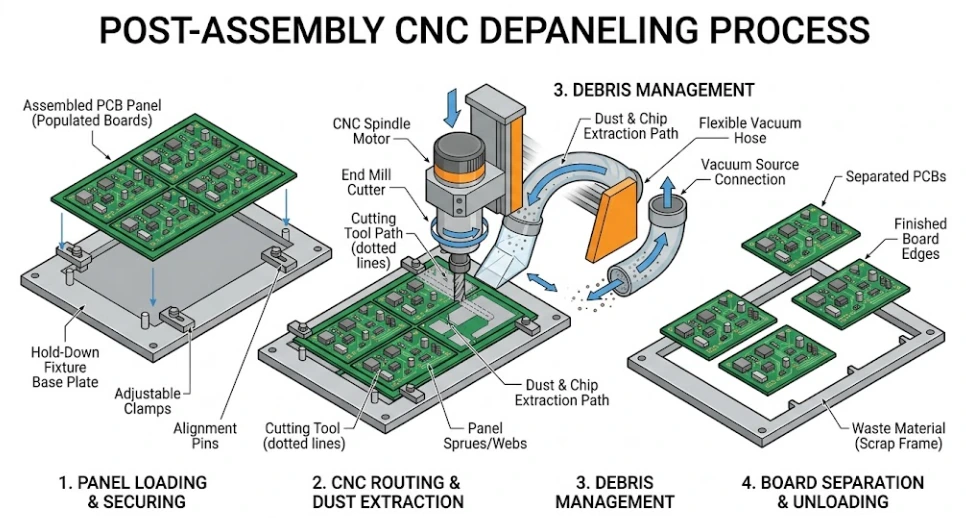
CNC routing after assembly produces the cleanest edge quality of any mechanical method and eliminates board flex stress entirely — the router bit cuts through the remaining tab or V-score web without bending the board. The post-assembly routing program is generated from the same board outline data used for bare-board fabrication. Required for high-reliability automotive (IATF 16949), medical (ISO 13485), and aerospace programs where documented process control is mandatory. Our inline APTPCB depaneling services are available as part of turnkey PCB assembly.

UV Laser Post-Assembly Depaneling
The highest-quality post-assembly singulation method. A focused UV laser beam cuts through tab or V-score web material without physical contact — no vibration, no flexure, no mechanical stress of any kind transmitted to the assembled board or its components. Critical advantages: zero stress on MLCCs placed 0.1–0.2 mm from the singulation line; no vibration that could crack BGA solder joints in large-format packages; no mechanical contact that could dislodge loosely-seated connectors or antenna modules. Increasingly specified for automotive ADAS sensor boards (77 GHz radar) and medical device assemblies where field-failure solder joint analysis would be catastrophic.

Automated post-assembly PCB depaneling station with CNC or laser singulation

Cost Optimization

Panelization & Profiling Cost Optimization

Profiling method selection and panelization design are among the highest-leverage per-unit cost reduction opportunities in volume PCB production. Engineering decisions made at the design stage — not after — have the greatest impact.

V-Score Whenever Board Shape Allows

V-score panels have zero routing kerf waste between boards - a 50 × 50 mm board on an 18 × 24 inch panel yields 108 boards vs. approximately 88 with CNC routing gaps. That 23% material utilization difference translates directly to per-unit laminate cost at volume. When board geometry is rectangular and edge cosmetics are not critical, V-score should be the default choice. If minor board edge features prevent strict V-score usage, evaluate hybrid approaches: V-score on two parallel sides, CNC routing only on the two sides with edge features.

Optimize Board Dimensions for Panel Fit

A 1–2 mm change in board outline can increase boards per panel by 10–20% in cases where the current dimension falls just above a panel-fraction boundary. On a 10,000 unit production run, this can eliminate one or two full production panels — saving material, process time, and per-unit cost. Submit your board outline to our CAM team early, before finalizing the PCB layout, to evaluate panelization optimization options while there is still design flexibility.

Consolidate Internal Cutouts

Each internal cutout adds plunge routing time — typically 30–60 seconds per cutout depending on complexity. Multiple complex internal cutouts can add significant per-panel routing time. Where possible, design connector access windows as simple rectangular shapes (faster to route than rounded or irregular geometries) and combine adjacent cutouts into a single larger window where mechanical design permits.

Cost DriverImpactOptimization
Panel utilizationDirect material cost per boardUse V-score, optimize board dimensions
Routing complexityRouting cycle time per panelSimplify cutout shapes, minimize count
Edge platingAdditional plating processSpecify only where functionally required
Gold finger bevelingAdditional machining stepStandard 20° / 30° vs. custom angle
Laser depanelingHigher per-board cycle timeUse only where stress-free is required
Post-assembly depanelingAssembly line integration costMatch method to volume and quality tier

Submit Board Outline Early for Panelization Review

Share your board outline and assembly panel requirements during initial quoting — before committing to a fixed PCB footprint. Our CAM engineers evaluate multiple array configurations and provide per-unit cost breakdowns for each option, including both V-score and CNC-routed variants where applicable, so you make an informed decision with full cost visibility.

FAQ

Frequently Asked Questions — PCB Depaneling & Profiling

What is the difference between PCB depaneling and PCB profiling?
PCB profiling refers to cutting the board outline shape during fabrication - the process of creating the finished board perimeter from a larger manufacturing panel. PCB depaneling specifically refers to separating individual boards from a panel array that has been assembled (SMT soldered) as a unit. Both use the same methods (CNC routing, V-score, laser), but profiling happens during bare-board fabrication and depaneling happens after assembly. The terms are often used interchangeably in casual usage, but in a production context they describe different process steps with different quality implications - depaneling after assembly requires zero-stress methods to protect solder joints.
What PCB depaneling methods do you offer?
We offer five PCB singulation methods: (1) CNC routing - any shape, ±0.1 mm accuracy, suitable for all materials; (2) V-score / V-cut - straight lines only, maximum panel utilization, lowest cost for rectangular boards; (3) tab routing with mouse-bite perforations - any shape with panel retention for SMT assembly; (4) UV laser depaneling - zero mechanical stress, ±0.05 mm accuracy, required for flex and thin boards; (5) punch / die cut - high-volume flex PCB singulation. We recommend the optimal method based on board geometry, material, production volume, and assembly requirements during DFM review.
What is V-score (V-cut) PCB and how does it work?
V-score (also called V-cut or V-groove) is a panel separation method where a rotary blade scores a V-shaped groove from both sides of the PCB panel along the intended board separation line. The blade does not cut all the way through - it leaves a 0.3-0.5 mm residual web of material that holds boards together during SMT assembly. After assembly, the boards are separated by applying a bending force along the score line, snapping the residual web cleanly. V-score is the most cost-effective depaneling method for rectangular boards because it requires no gap between boards (unlike CNC routing, which removes a 1.6-2.4 mm kerf). V-score is limited to straight separation lines and requires ≥0.5 mm component clearance from the groove center line.
What are mouse-bite holes in PCB tab routing?
Mouse-bite holes (also called stamp holes or breakaway perforations) are a row of small non-plated through-holes (typically 0.5-0.6 mm diameter, spaced 0.75-1.0 mm apart) drilled along the intended breakaway line in a tab-routed PCB panel. The perforations are placed within the 2.0-3.0 mm connection tab that holds the board to the panel rail. When the board is separated from the panel after assembly, the perforations act as a tear-line - the board snaps cleanly along the hole row with moderate force. Mouse-bite tabs leave a small nub at each tab location that can be trimmed if needed. The breakaway force is controlled by adjusting hole spacing - closer holes require less force but may cause premature separation during assembly handling; wider spacing increases force but improves panel rigidity. Mouse-bite tabs are the preferred method when boards are non-rectangular but must still be held in a panel array for SMT assembly.
What is PCB castellation (edge plating)?
PCB castellation refers to copper-plated half-holes along the board edge that create solder pads for surface-mount attachment of the PCB as a module onto a larger motherboard. The process starts with drilling full-diameter through-holes along the intended board edge line, electroplating them with copper (same process as standard PTH vias), then routing through the hole centerline during final board profiling to expose the half-circle (half-moon) plated wall. The resulting castellated edge allows the module to be placed on pads on a motherboard and reflow-soldered, creating a solder fillet on both the castellated wall and the motherboard pad. Castellation is commonly used for Wi-Fi, Bluetooth, LoRa, GPS/GNSS, and power management modules that are sold as standalone SMT-attachable components. Minimum castellation hole diameter is 0.6 mm; typical production diameters are 0.8-1.2 mm.
When should I use laser depaneling instead of CNC routing?
Laser depaneling is required or strongly recommended in four situations: (1) Flex PCBs and rigid-flex boards - laser avoids delamination of the polyimide-copper interface near the rigid-to-flex boundary that CNC routing stress can cause; (2) Ultra-thin boards (<0.8 mm) - mechanical routing causes chatter and board flexure that may warp thin laminates or crack solder joints; (3) Components within 0.1-0.2 mm of the board edge - CNC routing requires ≥0.3 mm clearance, laser allows ≥0.1 mm; (4) Assembled boards with ceramic chip capacitors (MLCCs), fine-pitch BGAs, or QFN packages close to the panel break line - laser's zero-stress singulation eliminates the micro-fracture risk that mechanical vibration creates in ceramics. Laser depaneling costs more per board (higher cycle time) than CNC routing, so it's typically reserved for designs where the mechanical methods cannot meet edge quality, stress, or component-clearance requirements.
What gold finger bevel angle should I specify — 20° or 30°?
The standard bevel angle for most card-edge connector applications is 20°. Use 30° when: the connector slot is particularly narrow and a more aggressive chamfer is needed to guide the card into the opening without the edge catching on the slot entry; the PCB is thicker than standard (>1.6 mm) and the 20° bevel doesn't sufficiently taper the edge; or the connector manufacturer's specification explicitly calls for 30°. For all PCIe, DDR, M.2, SODIMM, and PCI applications, 20° is the correct default. The bevel depth is typically set to remove 30-50% of the edge thickness - deeper bevels require more gold plating area to ensure full coverage on the bevel face after machining. Specify the bevel angle, depth percentage, and which board edge(s) require beveling in your fabrication notes.
What is the minimum internal cutout size in a PCB?
The minimum internal cutout width is 1.0 mm for CNC routing (limited by the smallest practical router bit diameter that maintains structural rigidity during cutting). Minimum internal corner radius is equal to the router bit radius - typically 0.5-0.8 mm for standard production tooling. For tighter internal corners (< 0.5 mm radius), sequential overlapping plunge cuts can approach the corner more closely, but this increases routing time and is limited to non-plated cutouts. Plated internal slots (slots with copper-plated walls for connector termination) have a minimum width of 0.6 mm and must be defined during layer imaging before routing - they cannot be plated after routing. For internal cutouts in Rogers PTFE or flex substrates, laser machining can achieve smaller minimum dimensions (0.3-0.5 mm slot width) than CNC routing.
How do fiducial marks affect panelization and depaneling?
Fiducial marks are copper reference targets that automated assembly and depaneling equipment uses for optical alignment. For SMT assembly, global fiducials at the panel rail corners allow the pick-and-place machine to compensate for any panel position offset or rotation on the conveyor. Local fiducials at two corners of each individual board allow fine-correction for board-to-board position variation within the panel. For automated post-assembly CNC or laser depaneling, local fiducials are essential - without them, the depaneling router cannot correct for accumulated position variation between the bare-board routing coordinate system and the post-assembly panel position. Standard fiducial specification: 1.0 mm diameter soldermask-exposed copper circle, 3 mm copper-free annular keepout, minimum three per panel and two per board in diagonally opposite corners.
What is the maximum panel size you can process?
Our standard maximum production panel size is 18 × 24 inches (457 × 610 mm). This is the most common large-format PCB panel size and optimizes utilization across our routing, plating, imaging, and inspection equipment. Some smaller specialty panels are available for low-volume or prototype work: 12 × 18 inches (305 × 457 mm) for medium builds, and custom panel sizes down to minimum 50 × 50 mm for specific applications. If you have a design requiring panels larger than 18 × 24 inches - for example, backplane segments or large-format LED arrays - contact our engineering team to discuss options.


Global Engineering Reach

PCB Depaneling & Profiling Services for Engineers Worldwide

Engineering teams across consumer electronics, automotive, aerospace, and industrial sectors on four continents rely on APTPCB for precision board singulation, panelization design, and specialty edge treatments. Online Gerber upload, same-day DFM review, and worldwide shipping simplify international procurement.

North America
USA · Canada · Mexico

Silicon Valley hardware startups ordering complex CNC-routed IoT board outlines, server backplane gold-finger beveling for PCIe Gen5 cards, defense avionics with internal cutouts and castellation, and medical device boards requiring IPC-A-600 Class 3 documentation and CMM dimensional verification.

DefenseServer/BackplaneMedicalIoT
Europe
Germany · UK · France · Nordic

German automotive Tier-1 suppliers requiring ±0.1 mm housing-fit ECU routing with IATF 16949 process documentation; UK telecom module manufacturers using castellation for Wi-Fi and LTE-M modules; French industrial automation boards with complex internal cutouts and V-score high-volume arrays.

Automotive IATFTelecom ModulesIndustrial
Asia-Pacific
Japan · South Korea · Taiwan · India

Consumer electronics manufacturers in South Korea and Taiwan requiring laser depaneling for ultra-thin smartphone boards and flex circuits; Japanese industrial equipment OEMs with precision MCPCB routing for LED luminaire production; Indian IoT hardware startups ordering castellated module prototypes with 24-hour DFM review.

Smartphone/FlexLED/MCPCBIoT Modules
Israel & Middle East
Israel · UAE · Saudi Arabia

Israeli aerospace and defense contractors requiring complex avionics board outlines with internal cutouts and IPC-A-600 Class 3 edge quality documentation; UAE and Saudi industrial electronics manufacturers using V-score high-volume arrays for power supply and energy management PCBs.

AerospaceDefenseEnergy

Ready to Define Your PCB Depaneling Requirements?

Share your board outline data, panelization preferences, edge treatment needs, depaneling method, and production volume. Our CAM engineers review your design, optimize the panel array for material utilization and assembly compatibility, and return DFM feedback with quotation within one business day.