Industrial PCB metrology facility with flying probe testing and X-Ray inspection

Zero-Defect Assurance Architecture

IPC Class 3 Metrology & Advanced PCB Reliability Control

In aerospace, medical, and automotive electronics, component failure is not an option. APTPCB enforces a strict zero-defect mandate through industrial metrology, including 100% Kelvin 4-wire electrical testing, dynamic TDR impedance verification, and destructive microsectioning to ensure every via barrel and trace geometry strictly exceeds IPC-6012 Class 3 and IATF 16949 standards.

100% E-Test
Zero AQL Sampling
IPC Class 3
Microsection QA
IATF 16949
Automotive PPAP

Get an Instant Quote

100% Flying ProbeElectrical Integrity
Inner Layer AOISub-Mil Defect Capture
TDR Impedance±5% Verification
MicrosectioningDestructive Analysis
3D X-RayRegistration Metrology
IATF 16949Automotive PPAP
ISO 13485Medical Certified
XRFFinish Thickness
100% Flying ProbeElectrical Integrity
Inner Layer AOISub-Mil Defect Capture
TDR Impedance±5% Verification
MicrosectioningDestructive Analysis
3D X-RayRegistration Metrology
IATF 16949Automotive PPAP
ISO 13485Medical Certified
XRFFinish Thickness

Defect Interception Network

Eradicating Latent Failures: Core Metrology Infrastructure

Relying solely on end-of-line testing is a catastrophic strategy for high-layer-count PCBs. APTPCB integrates metrology into every phase of the fabrication cycle. By combining high-resolution optical inspection before lamination with destructive thermodynamic testing after plating, we intercept and eliminate micro-shorts, via barrel voids, and impedance deviations before they reach your assembly line.

Pre-Lamination Validation

Inner-Layer AOI Optical Scanning

Once an inner layer is laminated, defects become permanent. Our high-resolution AOI scanners compare etched copper geometries directly against your ODB++ data down to a 0.5-mil threshold. This process captures acid-trap anomalies, pinholes, and micro-shorts before they are permanently entombed within the multilayer board structure.

Signal Integrity Assurance

TDR Impedance Verification

Simulation is not reality. We validate the actual Ohmic performance of your high-speed traces using Time Domain Reflectometry (TDR). By testing sacrificial coupons embedded in your specific production panel, we mathematically guarantee ±5% to ±10% Tolerance for PCIe Gen 5 and 112G SerDes protocols prior to shipment.

IPC Class 3 Compliance

Destructive Microsectioning

The only definitive way to prove IPC Class 3 via reliability is through destructive testing. We pot, slice, and polish samples from every lot to microscopically measure hole-wall copper thickness, verify zero resin smear, and confirm the absolute integrity of inner-layer interconnect bonds.

Electrical Integrity

Eliminating Latent Opens: 100% Kelvin 4-Wire Electrical Testing

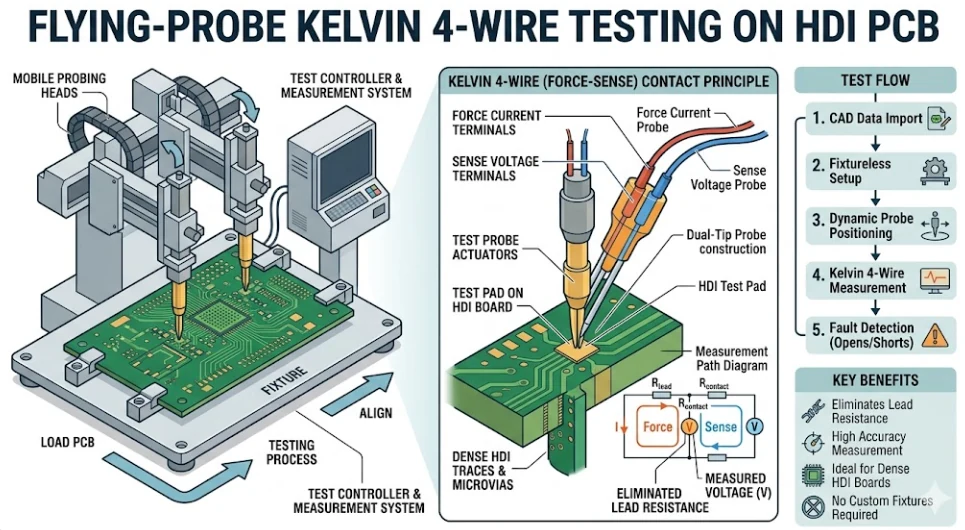
In dense HDI and 64-layer backplane designs, a "near-open" (a via barrel with dangerously thin plating) will pass a standard low-voltage continuity test, only to fracture during the thermal shock of SMT wave soldering. APTPCB strictly utilizes Kelvin 4-Wire measurement technology to eradicate this risk.

By using separate probe pairs to supply current and measure voltage drop independently, we accurately measure milliohm-level resistances. For prototypes, our multi-head Flying Probe systems execute these tests with surgical precision. For mass production, custom-built Bed-of-Nails fixtures perform simultaneous high-voltage isolation (Hi-Pot) testing at 250V+, guaranteeing absolute dielectric integrity between adjacent high-density nets.

This testing framework works in tandem with our fabrication controls and via drilling and plating discipline so electrical verification is tied directly to the structures most likely to fail in the field.

Flying probe tester performing Kelvin 4-wire electrical testing on an HDI PCB

Acceptance Standards

IPC-6012 Quality Assurance & Metrology Parameters

Our transparent quality baselines for industrial, medical, and aerospace interconnect fabrication.

Inspection / Test DisciplineMetrology StandardAPTPCB Execution ProtocolB2B Value Impact
Automated Optical Inspection0.5-mil Optical Resolution100% scan of all inner/outer layers vs. ODB++ dataPrevents layer-entombed shorts and signal loss
Electrical Continuity / IsolationKelvin 4-Wire / High-Voltage100% Coverage (No AQL Sampling). >20MΩ IsolationGuarantees zero latent opens or field failures
Via Barrel Plating ThicknessIPC-6012 Class 2 / Class 3Destructive Microsection (Min 20μm - 25μm Cu)Ensures vias survive thermal shock & vibration
TDR Impedance Verification±5% to ±10% ToleranceTested on 100% of production panel couponsValidates Signal Integrity for High-Speed Digital
Inner-Layer Registration3D X-Ray MetrologyPre-drill dynamic coordinate scaling based on LVDTPrevents annular ring breakout in 32L+ boards
Thermal Shock / Solder Float288°C for 10 SecondsSimulates extreme wave soldering conditionsProves zero risk of delamination or pad lifting
Surface Finish MetrologyXRF (X-Ray Fluorescence)Measures ENIG Ni/Au thickness to nanometer scaleGuarantees perfect shelf-life and wire-bonding

Note: For IATF 16949 automotive applications, full PPAP Level 3 documentation including CPK (Process Capability Index) data is generated for critical dimensions, impedance targets, and plating thicknesses.

Global Compliance

Certified Manufacturing Excellence

Our facility operates under the most stringent international quality management systems, providing full traceability and regulatory compliance for Tier-1 OEMs.

Automotive

IATF 16949:2016

The gold standard for automotive supply chains. We execute rigorous APQP, perform FMEA, and provide complete Level 3 PPAP documentation for EV and ADAS electronics.

Medical

ISO 13485:2016

For life-critical medical electronics, we enforce strict lot traceability, risk management protocols, and comprehensive process validation for FDA/CE marked devices.

Foundation

UL 94V-0 & ISO 9001

All materials and processes are audited to meet UL 94V-0 flammability standards. Our ISO 9001:2015 framework ensures continuous improvement and strict SPC controls.

APTPCB Quality Engineering Whitepaper

Deep Insight: The Physics of Latent Defect Interception

For lead hardware engineers and QA directors, a "passed" electrical test is not the end of the conversation. True quality assurance requires understanding the physiochemical boundaries of PCB fabrication. APTPCB's metrology infrastructure is designed to expose and intercept defects at a molecular level.

1. Microsectioning: The Ultimate Truth of IPC Class 3 Reliability

Electrical testing confirms a DC connection exists, but it cannot confirm the robustness of that connection. A plated through-hole (PTH) might have a microscopic void or desperately thin copper in the center of the barrel due to poor "throwing power" in the electroplating bath. This via will pass an E-Test, but it will catastrophically fracture under the Z-axis thermal expansion (CTE) stress of a 260°C lead-free reflow oven.

2. TDR and the Reality of Ohmic Impedance Control

APTPCB does not rely solely on software simulation. We utilize Time Domain Reflectometry (TDR) to inject a fast-rise-time step pulse into specific test coupons manufactured on the margins of your exact panel. By measuring the reflected waveform, we calculate the true Ohmic impedance of the physical structure. Through closed-loop feedback with our CAM dynamic etch-compensation algorithms, we reliably hold ±5% impedance tolerances, guaranteeing pristine signal integrity for your 112G PAM4 architectures.

3. X-Ray Metrology and Annular Ring Management

In high-layer-count boards (e.g., 32 layers), the FR-4 and Prepreg materials shrink and expand non-linearly under the extreme heat and pressure of the hydraulic lamination press. If we CNC drill the board based purely on theoretical CAD coordinates, the drill bit will miss the internal copper pads entirely, causing a "breakout" or total open circuit.

4. Conductive Anodic Filament Resistance Testing

For high-voltage industrial systems and dense servers, CAF is a silent killer. It is the electrochemical migration of copper ions along the glass fiber interface between two adjacent vias, leading to an internal short circuit. This defect is invisible to AOI and E-Test.

APTPCB manages CAF risk through material science and rigorous qualification. We utilize CAF-resistant, high-Tg base materials with specialized silane treatments. To prove our process, we subject test coupons to extreme Temperature-Humidity-Bias (THB) testing (e.g., 85°C / 85% RH / 100V DC for 1000 hours). We continuously monitor the insulation resistance; any drop indicates CAF growth. By optimizing our drill feed rates to prevent glass-fiber shattering and utilizing aggressive plasma desmear, we ensure the structural integrity of the dielectric matrix remains impervious to ionic migration.

5. The Electrochemical Dynamics of Solder Mask Adhesion

Solder mask flaking during assembly is a critical failure mode. APTPCB ensures maximum Liquid Photo-Imageable (LPI) solder mask adhesion through strict pumice scrubbing and micro-etching protocols prior to mask application. We test mask adhesion using the IPC-TM-650 cross-hatch tape test on sacrificial coupons from every lot. Furthermore, we maintain strict control over the final UV/Thermal curing ovens to prevent mask brittleness, which can lead to micro-cracking during the thermal shock of wave soldering.

6. Statistical Process Control (SPC) in Etch Compensation

Consistency is the hallmark of quality. Our chemical etching lines are monitored by automated ORP (Oxidation-Reduction Potential) and specific gravity sensors that inject replenisher chemistry in real-time. By utilizing Statistical Process Control (SPC), we track the "Etch Factor" (the ratio of vertical etch depth to lateral undercut) continuously. This allows us to calculate process capability indices (Cpk). If the Cpk drops below 1.33, the system automatically alerts process engineering to intervene, ensuring that the 4-mil impedance traces on the 10,000th panel are identical to those on the 1st panel.

7. Thermal Effects on Dielectric Withstanding Voltage

For PCBs operating in high-voltage environments (e.g., EV Battery Management Systems), the dielectric withstanding voltage (DWV) is critical. While standard FR-4 has a high intrinsic dielectric strength, micro-voids introduced during lamination or drilling stress can create pathways for voltage breakdown. APTPCB utilizes vacuum hydraulic lamination presses to extract entrapped air, and we execute destructive microsectioning to verify void-free resin encapsulation between critical high-voltage nets. This is validated by subjecting finished boards to extreme Hi-Pot testing, injecting up to 2.5kV DC to ensure absolute isolation.

8. Surface Finish Coplanarity via XRF

Fine-pitch BGA yield depends heavily on finish flatness and thickness control. We use XRF to verify nickel and gold deposition, support finish selection such as ENIG, ENEPIG, and immersion silver, and prevent hidden finish drift from affecting solderability, wire-bonding, or shelf-life performance.


Expert FAQ

Frequently Asked Questions: PCB Metrology & Quality

What is the difference between IPC Class 2 and IPC Class 3?
Class 2 is for standard commercial electronics where continuous performance is desired but not critical. Class 3 is for high-reliability military, aerospace, and medical equipment where downtime is unacceptable. Class 3 strictly forbids any annular ring breakout and mandates a thicker, flawless copper plating within the via barrel (minimum 20μm).
Does APTPCB perform 100% electrical testing, or do you sample?
We enforce a strict NO SAMPLING policy. 100% of the boards we manufacture—whether it's a 5-piece prototype order or a 50,000-piece mass production run—undergo complete Kelvin 4-wire continuity and high-voltage isolation testing before shipment.
Why do you use Kelvin 4-Wire testing instead of standard 2-wire?
Standard 2-wire testing is skewed by the resistance of the test probes themselves. Kelvin 4-Wire testing uses separate pairs of probes to supply current and measure voltage independently. This allows us to accurately measure milliohm-level resistances, detecting 'near-opens' (such as a cracked via barrel) that standard testing would incorrectly pass.
What is included in a PPAP Level 3 package for automotive boards?
Our IATF 16949 PPAP Level 3 documentation includes the Design/Process FMEA, Control Plan, Dimensional Results (CMM data), Material Certifications, Microsection Micrographs, Solderability Test Results, and full SPC capability studies (Cpk) for critical parameters like impedance and plating thickness.
How does Inner Layer AOI prevent expensive scrap?
Once an inner layer is laminated into a multilayer board, it is permanently entombed. Automated Optical Inspection (AOI) scans the etched inner layers before lamination, catching defects like micro-shorts. This allows us to scrap a single inner core rather than a fully pressed, drilled, and plated 32-layer backplane.
How do you verify ±5% controlled impedance tolerances?
We calculate the exact pressed thickness of the prepreg and apply dynamic etch-compensation to the phototool. We then validate the physical result by testing sacrificial TDR (Time Domain Reflectometry) coupons built into the margins of your specific production panel. We do not rely solely on software simulations.
What is a Microsection (Cross-Section), and why is it necessary?
Microsectioning is a destructive test where we cut a board in half, polish the edge, and inspect the internal via structure under an electron microscope. It is the ONLY way to definitively prove IPC Class 3 compliance, allowing us to measure exact hole-wall copper thickness and verify the absence of inner-layer separation.
How do you test for Conductive Anodic Filament (CAF) resistance?
CAF occurs when moisture and high voltage drive copper ions along micro-fractures in the glass weave, causing internal shorts. We mitigate this through material selection (CAF-resistant high-Tg laminates) and validate it by subjecting test coupons to severe Temperature-Humidity-Bias (THB) testing (e.g., 85°C / 85% RH / 100V DC).
Do you perform High-Voltage Isolation (Hi-Pot) testing?
Yes. For high-voltage industrial and power supply boards, standard 10V isolation testing is insufficient. We utilize dedicated Bed-of-Nails fixtures capable of injecting 250V+ DC to guarantee absolute dielectric isolation between high-density nets without breakdown.
How is X-Ray used in PCB fabrication?
We use 2D/3D X-Ray metrology primarily for registration alignment. After lamination, materials shrink unpredictably. X-Ray allows us to "see" the internal copper fiducials, letting our CAM software dynamically scale the CNC drill coordinates so the drill hits the exact center of the hidden pads.
How do you verify the thickness of ENIG or Hard Gold finishes?
We utilize X-Ray Fluorescence (XRF) metrology. This non-destructive testing method bombards the surface finish with X-rays and reads the secondary fluorescent emissions. This allows us to measure the exact nanometer thickness of the Nickel and Gold layers to ensure compliance and prevent "Black Pad" syndrome.
What is Solder Float Testing (Thermal Stress)?
To simulate the extreme thermal shock of lead-free wave soldering, we float a board sample in molten solder at 288°C for 10 seconds. We then microsection the sample to ensure the extreme heat did not cause the via copper barrels to crack or the laminate layers to delaminate.
Can I request a First Article Inspection (FAI) report?
Absolutely. For new product introductions (NPI), we can provide a comprehensive FAI report that details the physical measurement of every critical dimension (board outline, hole sizes, impedance) against the master mechanical drawing, ensuring the first board matches your exact specifications.
How does APTPCB track raw material traceability?
Through our ERP system, every production panel is laser-etched with a unique 2D barcode. This links the specific board to the exact lot of FR-4 laminate, prepreg, and chemical baths used during its fabrication, ensuring full root-cause traceability required by ISO 13485 and IATF 16949.
What if a defect is found during final electrical testing?
The board is immediately destroyed and discarded. We operate under a strict zero-defect policy. If multiple defects indicate a systemic process drift, our SPC (Statistical Process Control) system alerts engineering to halt the line, identify the root cause, and correct the chemical or mechanical parameter before resuming.

Global Quality Reach

Tier-1 QA Services for Engineers Worldwide

Engineering teams across the globe rely on APTPCB's rigorous metrology data and process documentation for mission-critical hardware deployment.

North America
USA · Canada · Mexico

Hyperscale compute, defense, and advanced digital hardware programs rely on TDR reports, Kelvin testing, and documented QA evidence for complex multilayer builds.

HyperscaleDefenseTDR
Europe
Germany · UK · France · Nordic

Automotive and medical device manufacturers depend on PPAP-ready quality systems, ISO-driven traceability, and metrology evidence for critical assemblies.

AutomotiveMedicalPPAP
Asia-Pacific
Japan · South Korea · Taiwan

Telecom and RF production teams use our zero-defect QA framework to support high-volume manufacturing of high-speed and high-frequency hardware.

5G TelecomMass ProductionRF
Middle East
Israel · UAE

Aerospace and avionics programs value IPC Class 3 microsection analysis and X-Ray-driven registration control for advanced electronics.

AerospaceClass 3Avionics

Ready to Partner with a Zero-Defect Manufacturer?

Upload your Gerber, ODB++, or CAD data. Our Quality Engineers will review your exact testing requirements, impedance specifications, and IPC Class 3 demands to provide a comprehensive, transparent fabrication quote within 24 hours.