Engineering for custom multilayer PCB stack-ups

Advanced Engineering Services

Custom PCB Stack-Up Design & Manufacturing

The foundation of every reliable high-speed, RF, and high-layer-count board is a stack-up that has been engineered for signal integrity, resin flow, thermal stability, and manufacturability. APTPCB delivers complete stack-up design support from standard FR-4 multilayers to hybrid PTFE backplanes, HDI sequential lamination, rigid-flex transitions, and heavy-copper power boards.

4 to 64
Layer Counts
Polar Si9000
Impedance Modeling
Hybrid
Material Expertise

Get an Instant Quote

Polar Si9000SI Simulation
Up to 64 LayersBackplane Ready
Hybrid StacksRF + Digital
Sequential LaminationHDI Microvias
TDR VerifiedImpedance Control
Resin FlowCalculated Pressing
4 to 64 LayersFull Range
HDI Any-LayerAdvanced Architecture
Polar Si9000SI Simulation
Up to 64 LayersBackplane Ready
Hybrid StacksRF + Digital
Sequential LaminationHDI Microvias
TDR VerifiedImpedance Control
Resin FlowCalculated Pressing
4 to 64 LayersFull Range
HDI Any-LayerAdvanced Architecture

Engineering Foundation

Custom PCB Stack-Up Design & Manufacturing for Global Engineering Innovators

As a leading multilayer PCB manufacturer, APTPCB delivers advanced PCB stack-up design and fabrication to engineering teams across North America, Europe, and the Asia-Pacific. We understand that a circuit board is no longer just a mechanical carrier; it is a critical RF and high-speed digital component. Whether you are designing a compact wearable with HDI any-layer microvias, or deploying a 64-layer server backplane on ultra-low-loss materials, your design's success hinges on the physical stack-up — and our CAM engineering team ensures every layer configuration is validated for impedance control, thermal management, and manufacturability before production begins.

Our factory holds validated pressing recipes and lamination profiles for every major PCB substrate type. We support all mainstream laminates on the market according to your BOM — from standard FR-4 and high-Tg grades through ultra-low-loss high-speed materials, PTFE/ceramic-filled RF laminates, polyimide flex films, and metal-core thermal substrates. If your design specifies a particular material from any global supplier, we can source it and match it to our pressing profiles. For cost optimization, we specialize in hybrid material stack-ups, seamlessly combining expensive high-frequency laminates on critical outer layers with cost-effective FR-4 structural cores inside. This upfront engineering prevents costly respins and ensures your board performs exactly as simulated.

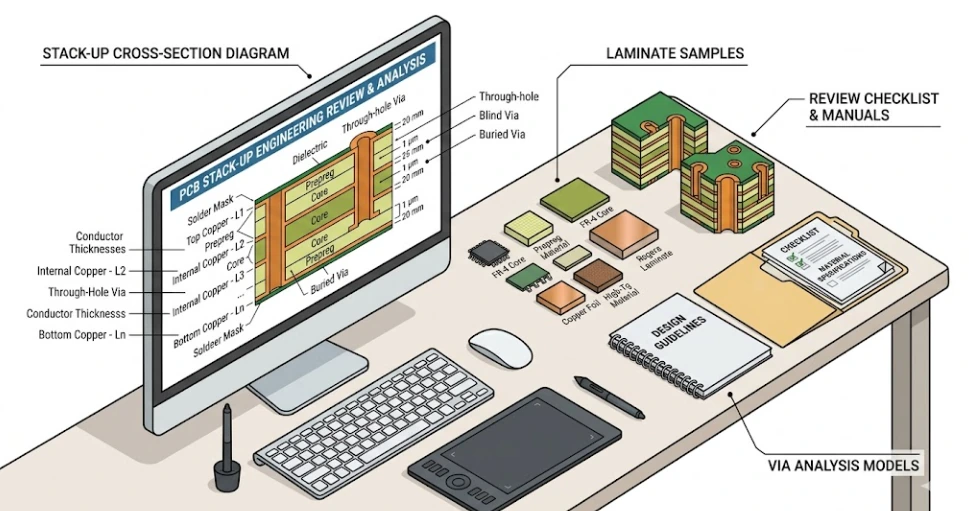
CAM engineer reviewing a detailed stack-up cross-section diagram

Stack-Up Architectures

All PCB Stack-Up Types We Manufacture

From standard multilayer FR-4 to complex rigid-flex bookbinder constructions, our factory holds validated pressing recipes for every major stack-up architecture.

Stack-Up TypeLayer RangeConstruction MethodKey MaterialsPrimary Applications
Standard FR-4 Multilayer4 – 16 LSingle lamination press cycle with mechanical through-hole viasShengyi S1000-2, ITEQ IT-180A, Nan Ya NPG-170/180, Ventec VT-47, KB-6167FIndustrial controls, consumer electronics, automotive ECU, IoT gateways
High-Speed / Low-Loss Multilayer8 – 20 LSingle lamination with tight registration; spread-glass prepregs; HVLP copperMegtron 4/6/7, Isola I-Tera MT40 / I-Speed, ITEQ IT-968/988G, Nelco N7000-2 HT, Shengyi S7439G10G/25G/100G networking, PCIe Gen4/5/6, DDR5, HPC
High-Layer-Count Backplane20 – 64 LMultiple press cycles; extreme aspect-ratio drilling; back-drilling for stub removalMegtron 6/7, Tachyon 100G, Isola I-Speed, ultra-low-loss prepregsData center switch fabrics, telecom backplanes, server motherboards, supercomputing
HDI (1+N+1 / 2+N+2 / Any-Layer)4 – 24 LSequential lamination; laser-drilled blind/buried microvias; VIPPO (via-in-pad plated over); ABF build-up film for any-layerStandard FR-4 cores + RCC or ABF build-up layers; thin prepregs (1080, 106)Smartphones, wearables, SSD controllers, fine-pitch BGA breakout, compact medical devices
Flex PCB1 – 8 LPolyimide core with adhesive or adhesiveless construction; coverlay instead of solder maskDuPont Pyralux AP/LF/HT, Panasonic Felios R-F775, Shengyi SF305C, Taiflex, Doosan FCCLFPC cables, dynamic hinge connections, wearable sensors, camera modules
Rigid-Flex4 – 20 LBookbinder or cross-hatch construction; rigid FR-4 sections bonded to flex polyimide sections with no-flow prepreg at transition zonesFR-4 cores + polyimide flex cores + no-flow / low-flow prepregs (e.g., Isola 185HR NF, Panasonic R-F661T)Aerospace interconnects, military avionics, foldable electronics, robotic arms, implantable medical devices
Aluminum MCPCB1 – 4 LAluminum base plate (1.0 – 3.2 mm) with thermally conductive dielectric layer (1 – 10 W/mK) and copper circuit layerBergquist HT-04503, Ventec VT-4B series, Totking TK series, Shengyi SA, Laird TgreaseHigh-power LED lighting, automotive headlamps, power converters, motor drives
Copper-Base MCPCB1 – 2 LCopper base plate (1.0 – 3.0 mm) with thin dielectric; thermal conductivity 2 – 4× higher than aluminum MCPCBCopper C1100 base + ceramic-filled dielectric; DBC (Direct Bond Copper) for highest performanceIGBT modules, high-power RF amplifiers, laser diode carriers, EV power electronics
Heavy Copper2 – 10 L3 oz to 20 oz copper on inner/outer layers; extreme resin-fill prepregs to prevent voids; mixed copper weights (heavy + standard) possible within a single stack-upHigh-resin-content prepregs (106, 1080); high-Tg FR-4 or polyimide substrates; any laminate per customer BOMEV charging stations, solar inverters, industrial motor drives, welding equipment, UPS systems, planar transformers
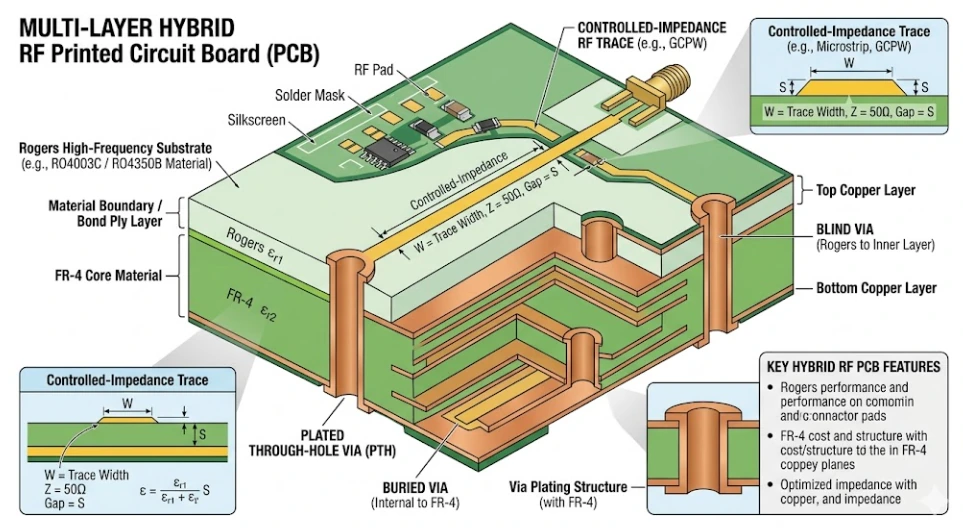
RF Hybrid (PTFE + FR-4)4 – 12 LMixed-dielectric construction bonding RF laminates on signal layers with FR-4 structural cores; CTE mismatch management with low-flow bondplyRogers RO4350B, RO4835, RO3003, RT/duroid 5880, Taconic RF-35, TLY, Arlon AD255, DiClad, Isola Astra MT77Automotive 77 GHz radar, 5G mmWave base stations, satellite transponders, phased-array antenna

All stack-up types are available for <a href="/en/pcb/quick-turn-pcb">quick-turn prototyping</a> and volume production. The materials listed above are representative examples — APTPCB supports all mainstream laminates on the market and can source any commercially available material per your BOM. Our CAM team provides a full stack-up diagram in PDF and ODB++ format for your approval before fabrication.

Rigid Multilayer

Standard & High-Layer-Count FR-4 Stack-Ups

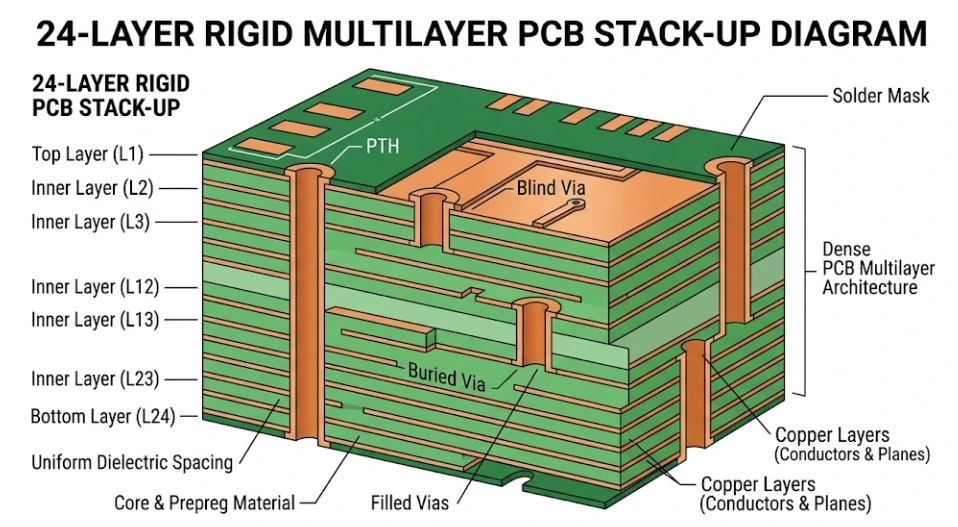
Standard multilayer stack-ups (4 – 16 layers) use a single lamination press cycle with symmetrical core/prepreg arrangement. The key to a successful standard stack-up is Z-axis symmetry — matching copper weight and dielectric thickness on opposite sides of the board center to prevent warpage during SMT reflow. We specify core and prepreg combinations that balance copper fill ratio with available resin volume to ensure void-free lamination.

High-layer-count backplanes (20 – 64 layers) push every manufacturing parameter to the limit: extreme aspect-ratio through-hole drilling, strict CTE control to prevent plated barrel cracking, back-drilling to remove via stubs on high-speed channels, and precise resin-flow calculations for dozens of prepreg sheets. These boards typically require ultra-low-loss materials (Megtron 6/7, Tachyon 100G) with spread-glass fabrics to minimize skew on differential pairs above 25 Gbps.

Cross-section microsection of a 24-layer high-speed PCB

HDI Architecture

HDI Sequential Lamination Stack-Ups

HDI stack-ups use sequential lamination to build layer by layer, creating blind and buried microvia interconnects that enable ultra-dense routing.

1+N+1

Single Build-Up HDI

One sequential lamination cycle adds one build-up layer on each side of the core. Laser-drilled blind microvias connect the build-up layer to the first inner layer. This is the most common and cost-effective HDI structure — suitable for smartphones, compact IoT, and moderate-density BGA fan-out. Typical via diameter: 75 – 100 µm.

2+N+2

Double Build-Up HDI

Two sequential press cycles per side. Microvias can be stacked (via-on-via) or staggered (offset). Stacked microvias require copper-filled via processing (VIPPO). This structure handles 0.4 mm pitch BGAs and provides additional routing channels for high-pin-count ICs. Two press cycles roughly double the cost of 1+N+1.

3+N+3

Triple Build-Up HDI

Three build-up layers per side for the highest routing density on a core-based construction. Enables 0.3 mm pitch and below. Each additional press cycle increases cost and lead time significantly but provides unmatched interconnect density for advanced mobile processors and chiplet packaging substrates.

ELIC

Any-Layer / Every-Layer Interconnect

All layers are build-up layers — no conventional core. Every layer connects to every other layer through stacked copper-filled microvias, using ABF (Ajinomoto Build-up Film) or ultra-thin RCC. This is the most advanced HDI architecture, used for the densest semiconductor package substrates and next-generation mobile SoC boards.

Flex & Rigid-Flex

Flexible & Rigid-Flex Stack-Up Construction

Flex PCB stack-ups replace FR-4 glass-epoxy with polyimide film (PI, Dk ≈ 3.2 – 3.5) as the base dielectric. Single-layer and double-layer flex use adhesiveless polyimide-copper laminates for the thinnest possible construction. Multilayer flex (3 – 8 layers) bonds multiple PI cores with adhesive or acrylic bonding films. Coverlay film replaces solder mask to maintain flexibility. Impedance control on flex requires trace-width adjustment for the lower Dk of polyimide.

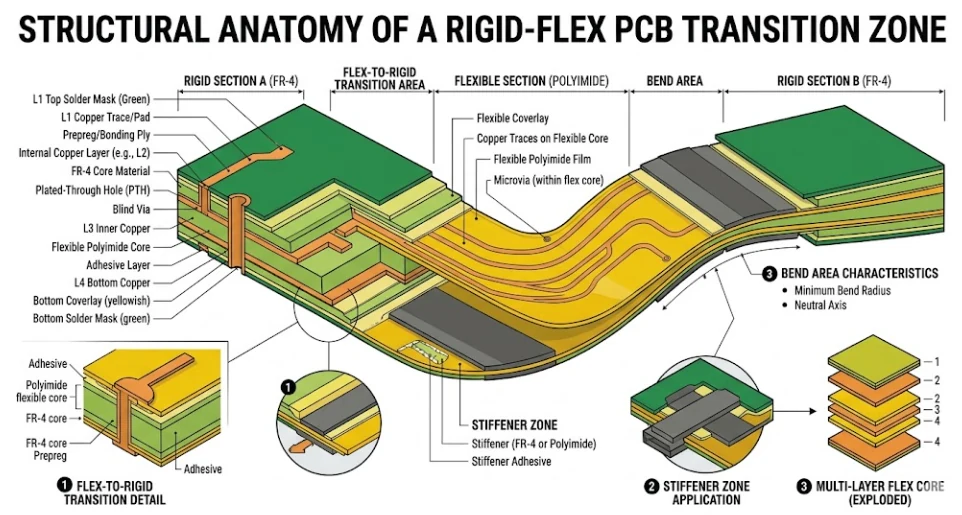
Rigid-flex stack-ups combine rigid FR-4 multilayer sections with flexible polyimide sections in a single integrated board. The construction uses "bookbinder" or "looseleaf" methods where flex layers pass continuously through the rigid zones while rigid-only layers are laminated above and below. No-flow or low-flow prepregs at transition zones prevent resin from bleeding onto the flex area and making it brittle. We design hatched ground planes on flex layers to maintain controlled impedance without sacrificing bend radius performance.

Rigid-flex PCB showing the transition between rigid FR-4 and flexible polyimide

Thermal & Power

Metal-Core & Heavy Copper Stack-Ups

Aluminum MCPCB stack-ups bond a copper circuit layer to an aluminum base plate through a thermally conductive dielectric layer. Standard thermal conductivity ranges from 1 – 3 W/mK for general LED applications, while premium ceramic-filled dielectrics reach 5 – 10 W/mK for high-power RF amplifiers and IGBT modules. Copper-base MCPCBs offer 2 – 4× the thermal performance of aluminum and are used in the most demanding thermal applications like laser diodes and EV power stages.

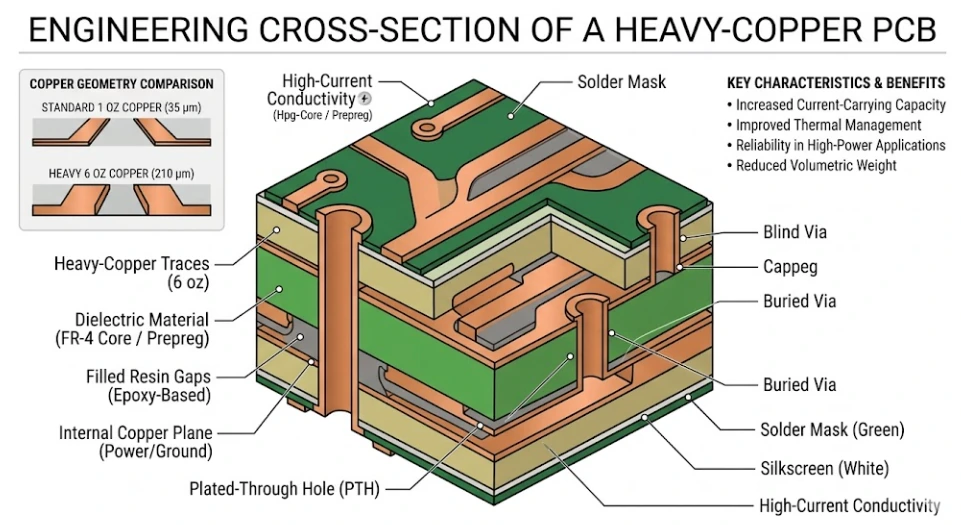
Heavy copper stack-ups (3 oz – 20 oz) carry high currents within a multilayer board. The main fabrication challenge is resin fill — thick copper layers with sparse routing create deep etched gaps that must be completely filled by melting prepreg during lamination. We calculate the copper retention percentage on every layer and select high-resin-content prepregs (106, 1080 styles) to prevent voids and delamination. Mixed copper weights (e.g., 2 oz on signal layers + 10 oz on power layers) are supported within a single stack-up, enabling combined power and control circuits on one board.

Heavy copper PCB cross-section showing fully filled resin gaps

RF & Mixed Dielectric

RF Hybrid Stack-Ups — PTFE + FR-4 Construction

RF hybrid stack-ups place high-frequency PTFE or ceramic-filled laminates (Rogers RO4350B, RO4835, RO3003, RT/duroid 5880, Taconic RF-35, TLY, Arlon AD255, Isola Astra MT77) on the RF signal layers while using cost-effective FR-4 for inner structural, power, and digital control layers. This approach delivers the RF performance of a full-PTFE board at a fraction of the cost.

The primary engineering challenge is CTE mismatch — PTFE materials expand at different rates than FR-4 during the heat of lamination and SMT reflow. We manage this by selecting compatible low-flow bondply materials, designing symmetrical constructions to balance the mechanical stress, and running thermal cycling validation on first articles. For high-frequency PCBs at 77 GHz automotive radar or 5G mmWave frequencies, we also specify HVLP copper foil and use frequency-dependent Dk data in the impedance simulation to ensure accuracy at the actual operating band.

Hybrid RF and FR-4 PCB showing the Rogers top layer

Manufacturing Capability

Stack-Up Engineering Parameters

Our lamination equipment and process controls support the full range of PCB stack-up complexity.

ParameterStandardAdvancedNotes
Maximum Layer Count16 Layers64 Layers64L backplanes require ultra-low-loss materials and multiple press cycles
Board Thickness Range0.4 – 3.2 mm0.20 – 8.0 mm0.20 mm for ultra-thin builds; 8.0 mm for thick backplanes
Minimum Core Thickness0.1 mm (4 mil)0.05 mm (2 mil)2 mil cores for HDI and mobile applications
Minimum Prepreg Thickness0.075 mm (3 mil)0.05 mm (2 mil)Thin prepregs required for tight dielectric control in high-speed designs
Sequential Lamination Cycles1 cycle (1+N+1)Up to 3 SBU (sequential build-up)Stacked and staggered microvias supported; each cycle adds ~3 – 5 days lead time
Maximum Copper Weight2 oz (70 µm)Up to 20 oz (700 µm)Mixed weights supported within a single stack-up; inner and outer layers both to 20 oz
Min Trace / Space3 / 3 mil2 / 2 milBoth inner and outer layers; LDI imaging at 2/2 mil
MCPCB Base Thickness1.0 – 1.6 mm AlUp to 3.2 mm Al / 3.0 mm CuCopper base available for highest thermal demands
Flex Bend Radius10× material thickness6× material thicknessDynamic flex (repeated bending) requires wider radius; adhesiveless construction preferred
Rigid-Flex Transition ZonesStandard taperControlled impedance through transitionNo-flow prepreg prevents resin bleed; hatched ground maintains Z₀ on flex
Thickness Tolerance± 10% (≥ 1.0 mm board)± 0.10 mm (< 1.0 mm board)Per APTPCB standard; tighter tolerance available on request for connector mating and card-edge applications

Need a Custom Stack-Up Design?

Upload your schematic or constraint list — our CAM team will propose an optimized stack-up with material recommendation, layer diagram, and DFM review within one business day.

Core vs. Prepreg — Understanding the Building Blocks

Every rigid multilayer PCB is built from two fundamental elements: cores and prepregs. A core is a fully cured laminate with copper foil bonded to both sides — it is mechanically rigid and dimensionally stable. A prepreg (pre-impregnated fabric) is woven fiberglass cloth coated with uncured or semi-cured (B-stage) resin — it is soft and tacky. During the lamination press cycle, heat and pressure melt the prepreg resin, which flows to fill the etched gaps in adjacent copper layers, then cures permanently to bond the stack-up into a solid monolithic structure.

The choice of glass fabric style directly affects the dielectric thickness and resin content. Common prepreg styles include 106 (high resin, thin), 1080 (medium resin, thin), 2116 (standard, medium thickness), 7628 (thick, low resin), and spread-glass variants 1035, 1067, and 1078 for improved Dk uniformity in high-speed applications. Our CAM team selects the specific combination of core thicknesses and prepreg styles to achieve your required total board thickness, dielectric spacing, and resin fill volume.

Material Systems for Different Stack-Up Types

APTPCB supports all mainstream rigid and flex laminates on the market according to your BOM — and can source any commercially available material to match your design requirements. We maintain pressing recipes and inventory relationships with major laminate families worldwide. Standard FR-4 grades (such as Shengyi S1000-2, ITEQ IT-180A, Nan Ya NPG-170/180, Ventec VT-47, Kingboard KB-6167, and equivalents) serve the majority of industrial and consumer applications with Tg from 130°C to 180°C+. Mid-loss materials (such as Isola 370HR, Shengyi S1000-2ME, ITEQ IT-958G, and equivalents) bridge the gap for 5 – 10 Gbps designs. Low-loss and ultra-low-loss grades (Megtron 4/6/7, I-Tera MT40, I-Speed, ITEQ IT-968/988G, Nelco N7000-2 HT, Tachyon 100G, and equivalents) handle the most demanding data center and HPC applications.

For RF and microwave stack-ups, we process the full range of PTFE and ceramic-filled laminates: Rogers RO4350B, RO4835, RO3003, RT/duroid 5880, Taconic RF-35, TLY, TLX, Arlon AD255, DiClad 880, Isola Astra MT77, Teflon PTFE, and equivalents. Flex and rigid-flex stack-ups use polyimide films from DuPont (Pyralux AP, LF, HT), Panasonic (Felios R-F775), Shengyi (SF305C), Taiflex, Doosan, and other qualified suppliers. Metal-core substrates include Bergquist, Ventec VT-4B, Totking, Shengyi SA, Laird, Henkel, and equivalents. If your design specifies a material not listed here, contact our CAM team — we can evaluate and source virtually any commercial laminate, prepreg, or bonding film to meet your exact requirements.

Stack-Up Design Best Practices

Z-Axis Symmetry

The single most important rule in multilayer stack-up design is symmetry about the board's center line. Match copper weights, dielectric thicknesses, and material types on opposite sides. An asymmetric stack-up will bow and twist during SMT reflow because the two halves expand and contract at different rates. If your design inherently requires asymmetry (e.g., more signal layers on one side), discuss it with our CAM team — we can recommend compensating strategies such as adding dummy copper fill or adjusting prepreg styles.

Copper Balancing & Resin Fill

Uneven copper distribution between adjacent layers creates resin flow imbalances during lamination. Layers with dense routing consume more resin to fill etched gaps, while layers with large copper pours consume less. This is especially critical in heavy copper builds (3 – 20 oz) where deep etched channels demand high-resin-content prepregs. We analyze the copper retention percentage on every layer and select prepreg resin content accordingly. Adding copper fill (thieving) to sparse areas also helps equalize the copper distribution and prevents localized resin starvation that leads to voids and CAF (Conductive Anodic Filament) failures.

Signal Layer & Reference Plane Pairing

Every high-speed signal layer should be directly adjacent to an unbroken reference (ground or power) plane. This pairing ensures consistent impedance control and provides a low-inductance return current path. Avoid placing two signal layers adjacent to each other without a plane between them — this causes severe crosstalk and makes impedance control impossible. A typical 8-layer high-speed stack-up follows the pattern: Signal – Ground – Signal – Power – Power – Signal – Ground – Signal.

Applications

Stack-Up Solutions by Industry

Data Center & Networking

High-Speed Backplane & Switch Fabric

20 – 64 layer ultra-low-loss stack-ups for 100G/400G Ethernet. Megtron 6/7 with spread-glass, back-drilled stubs, and tight TDR-verified impedance control on 56G/112G PAM4 lanes.

Automotive

ADAS Radar & EV Battery Management

Hybrid Rogers/FR-4 stack-ups for 77 GHz radar; heavy copper multilayer for BMS; aluminum MCPCB for LED headlamps. All meeting AEC-Q100 thermal cycling requirements.

Aerospace & Defense

Avionics & Phased-Array Antenna

Rigid-flex bookbinder stack-ups for 3D avionics enclosures. Polyimide and hybrid PTFE constructions with microsection verification per MIL-PRF-31032 and IPC-6012DS Class 3/A.

Medical

Implantable & Diagnostic Devices

Ultra-thin flex stack-ups for implantable sensors; HDI any-layer for portable ultrasound; rigid-flex for endoscope cameras. ISO 13485 traceability on every layer configuration.

Industrial & Power

Motor Drives & Solar Inverters

Heavy copper (3 – 20 oz) stack-ups with mixed copper weights for combined power and control circuits. Thermal management through embedded copper coins and metal-core substrates.

Consumer & Mobile

Smartphones, Tablets & Wearables

HDI 2+N+2 and any-layer stack-ups with VIPPO microvias for ultra-dense SoC breakout. Thin board profiles (0.4 – 0.8 mm) with impedance-controlled MIPI and USB lanes.

FAQ

PCB Stack-Up Design FAQ

What is the difference between a core and a prepreg?
A core is a fully cured laminate with copper foil bonded to both sides — it is rigid and dimensionally stable. A prepreg is fiberglass cloth coated with uncured (B-stage) resin — it melts during lamination under heat and pressure to bond cores together, fill etched copper gaps, and then cure permanently. The combination of core thicknesses and prepreg styles determines the final dielectric spacing and total board thickness.
Why must a stack-up be symmetrical?
Symmetry about the board's center line ensures that both halves of the PCB expand and contract at the same rate during the heat of SMT reflow (typically 245 – 260°C peak). An asymmetric stack-up — different copper weights, dielectric thicknesses, or materials on opposite sides — causes the board to bow and twist, leading to solder joint failures and component tombstoning. Our CAM team always verifies Z-axis symmetry before approving any stack-up for production.
What is sequential lamination and when is it needed?
Sequential lamination is the process of pressing a subset of inner layers first, drilling and plating them to create buried vias, then adding more prepreg and copper layers and pressing again. This is required for HDI boards with blind and buried microvias. The notation "1+N+1" means one build-up layer on each side of a core; "2+N+2" means two build-up layers per side. Each additional press cycle adds cost and lead time but enables much higher routing density.
Can you mix different materials in a single stack-up?
Yes — this is called a hybrid stack-up. The most common combination is Rogers PTFE on the RF signal layers with FR-4 structural cores, saving significant cost compared to an all-PTFE board. We also build hybrid stacks mixing low-loss materials (Megtron 6) on high-speed signal layers with standard FR-4 on power/ground planes. The key engineering challenge is CTE mismatch management — we use compatible low-flow bondply materials and symmetrical construction to prevent delamination.
How do you prevent resin starvation in heavy copper stack-ups?
Heavy copper layers (3 oz – 20 oz) with sparse routing create deep etched gaps that must be completely filled with resin during lamination. We calculate the exact copper retention percentage on every layer and select high-resin-content prepregs (106 and 1080 glass styles) to ensure enough molten resin flows to fill all voids. We also recommend adding copper thieving (fill patterns) to sparse areas to equalize the copper distribution across the panel.
What makes rigid-flex stack-ups different from regular multilayer?
Rigid-flex boards combine rigid FR-4 sections with flexible polyimide sections in a single monolithic construction. The flex layers run continuously through both zones (bookbinder method), while rigid-only layers are added above and below in the rigid zones only. Special no-flow prepregs prevent resin from bleeding into the flex area. The transition zone between rigid and flex requires careful engineering to maintain impedance control and prevent stress fractures.
What glass fabric styles are available for prepreg?
Common glass fabric styles include: 106 (very thin, high resin content — ideal for filling heavy copper gaps), 1080 (thin, medium resin — widely used in standard builds), 2116 (standard thickness — the most common general-purpose prepreg), 7628 (thick, low resin — used for structural layers in thick boards), and spread-glass variants 1035, 1067, and 1078 (open-weave with more uniform Dk — essential for high-speed differential pair routing above 10 Gbps).
Can I build an asymmetric stack-up if my design requires it?
We strongly advise against it, but yes — we can fabricate asymmetric stack-ups when the design absolutely requires it (e.g., single-sided heavy copper power plane). In such cases, we apply compensating measures: adding dummy copper fill on light layers, using specific prepreg combinations to equalize CTE, and running thermal simulation to predict warpage. We will always flag asymmetry in our DFM review and propose alternatives before production.
What is the minimum and maximum board thickness you support?
Our rigid PCB thickness range is 0.20 mm to 8.0 mm. Standard thickness tolerance is ±10% of nominal (or ±0.10 mm for boards under 1.0 mm); we offer tighter tolerance for precision applications like card-edge connectors and press-fit pins where mechanical tolerances are critical. For rigid-flex boards, the rigid section and flex section have independently specified thicknesses. Flex-only boards can be thinner depending on the polyimide construction.
Do you provide stack-up documentation with every order?
Yes. Every order includes a detailed stack-up diagram showing all layers, material grades, core/prepreg thicknesses, copper weights, and dielectric spacing — in both PDF and ODB++ format. For impedance-controlled boards, the stack-up document includes the simulated impedance values and trace-width adjustments. For IPC Class 3 and military builds, we also provide microsection photographs verifying the as-built dielectric dimensions match the design.

Interactive Tool

Stack-Up Complexity Estimator

Select your stack-up type to see the typical construction method, cost drivers, and engineering considerations.

Select Stack-Up Profile
Select a profile to view stack-up engineering details.

Global Engineering Reach

PCB Stack-Up Design for Engineers Worldwide

Hardware teams across telecom, automotive, aerospace, and data center industries rely on APTPCB for complex multilayer stack-up engineering with same-day DFM review and global logistics.

North America
USA · Canada · Mexico

Data center architects in Silicon Valley, defense contractors on the East Coast, and automotive Tier-1 suppliers in Detroit source our high-layer-count backplane and hybrid RF stack-ups for next-generation platforms.

BackplaneDefenseAutomotive
Europe
Germany · UK · Sweden · France

Automotive radar developers in Stuttgart, 5G infrastructure teams in Stockholm, and medical device companies in the UK rely on our rigid-flex and hybrid PTFE stack-up expertise.

Radar5GRigid-Flex
Asia-Pacific
Japan · South Korea · Taiwan · India

Consumer electronics innovators and server OEMs across APAC leverage our HDI any-layer and high-speed stack-up capabilities for compact mobile devices and hyperscale server boards.

HDIMobileServer
Israel & Middle East
Israel · UAE · Saudi Arabia

Aerospace radar programs and satellite communication designers in the region source our multi-material hybrid stack-ups with microsection verification and MIL-spec documentation.

AerospaceSatelliteHybrid

Get Your Custom Stack-Up Report

Share your layer count, material preference, and design constraints. Our CAM team will return a detailed stack-up diagram, material recommendation, and DFM review within one business day.