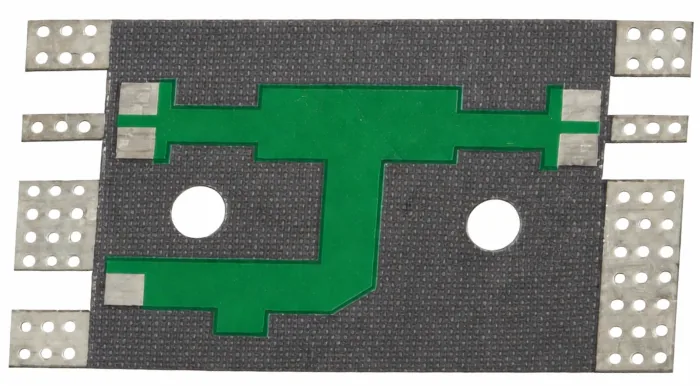
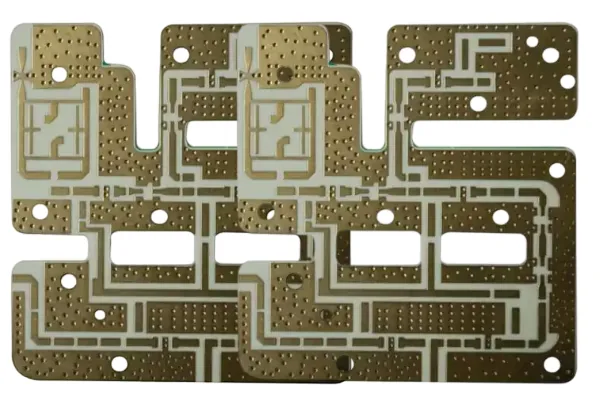
PTFE RF PCB stackup

PTFE High-Frequency Substrates

Teflon / PTFE PCB Manufacturing & Assembly

PTFE (polytetrafluoroethylene) - known commercially as Teflon - delivers the lowest dielectric loss of any PCB substrate material: dissipation factors as low as 0.0002 at 10 GHz on pure, unfilled formulations. APTPCB fabricates PTFE PCBs across the full spectrum of commercial formulations: woven-PTFE/glass from Rogers (RT/duroid 5880), Taconic (TLY-5A), and Arlon; ceramic-filled PTFE for Dk stability and antenna miniaturization (RO3003, CER-10); and thermoset PTFE alternatives (RF-35, RO4350B). Every PTFE build includes dedicated plasma desmear, validated drill programs, and TDR-measured impedance coupons.

Df down to 0.0009
Pure PTFE (10 GHz)
All Brands Processed
Rogers · Taconic · Arlon
Plasma + TDR
Validated Process

Get an Instant Quote

RT/duroid + RO3000 + TLYPTFE Portfolio
Plasma + NaOHSurface Activation
+/-0.5 milTrace Tolerance
Hybrid CapablePTFE + FR-4
TDR / VNAValidated
PTFE StockedFast Start
ISO 9001Certified
IPC-6012 CL3Acceptance
RT/duroid + RO3000 + TLYPTFE Portfolio
Plasma + NaOHSurface Activation
+/-0.5 milTrace Tolerance
Hybrid CapablePTFE + FR-4
TDR / VNAValidated
PTFE StockedFast Start
ISO 9001Certified
IPC-6012 CL3Acceptance

Why PTFE Matters for RF Design

Teflon & PTFE PCB Manufacturing for Global RF and mmWave Innovators

As a leading PTFE PCB manufacturer, APTPCB delivers ultra-low-loss substrate solutions to engineering teams across North America, Europe, and the Asia-Pacific. From LEO satellite engineers in California designing Ka-band transceivers to 77 GHz ADAS radar developers in Stuttgart, managing dielectric loss at frequencies above 5 GHz is the absolute critical path. While standard FR-4 generates 3-4 dB/inch of loss at 10 GHz, and standard thermosets like RO4350B reduce this to about 1 dB/inch, pure PTFE substrates (Df 0.0009) cut insertion loss by another factor of three. For mmWave applications, this is the margin between closing the link budget and signal failure.

Our factory processes every major commercial PTFE laminate brand: Rogers RT/duroid (5880, 6002), Rogers RO3000 series (RO3003, RO3010), Taconic (TLY-5A, TLX, CER-10), and Arlon (CLTE-XT). Unlike standard FR-4 board houses, we operate dedicated plasma desmear chambers (CF4/O2 gas mixtures) critical for activating inert PTFE hole walls before plating. We also offer sodium-naphthalenide wet chemistry, specialized low-friction drill programs, and hybrid PTFE/FR-4 stack-up engineering for demanding high-frequency PCB designs. Every PTFE PCB we ship includes TDR impedance coupon data and full IPC-6012 Class 3 documentation options.

PTFE laminate storage

Material Portfolio

Global Supply of PTFE Laminates: Rogers, Taconic & Arlon

Our factory holds validated processing recipes for every product listed below. We maintain a deep local inventory to bypass long material lead times for your most urgent RF prototypes.

SeriesBase ChemistryDk RangeDf (Typ. @ 10 GHz)Key CharacteristicsPrimary Applications
Rogers RT/duroid 5880PTFE / glass microfiber2.200.0009Lowest-loss commercial PTFE laminate - the benchmark for ultra-low-loss applications. Glass microfiber reinforcement. Requires plasma desmear for copper adhesion. Four decades of aerospace and defense heritage.Satellite LNA boards, Ka-band phased arrays, space-rated receiver front ends, VNA calibration substrates
Rogers RO3003PTFE / ceramic filler3.000.0013Exceptional Dk stability over temperature (+/-0.04 tolerance). The global benchmark for 77 GHz automotive radar. Low moisture absorption (0.04%). Plasma desmear required.77 GHz automotive radar (ADAS), mmWave 5G, automotive V2X, point-to-point backhaul
Rogers RO3006 / RO3010PTFE / ceramic filler (high-Dk)6.15 / 10.20.002 / 0.0023High dielectric constant PTFE for antenna miniaturization. RO3010 (Dk 10.2) enables about 68% antenna dimension reduction vs. Dk 3.5 substrates. Plasma desmear required.Miniaturized patch antennas, compact filters, dielectric resonator elements
Taconic TLY / TLY-5APTFE / woven E-glass2.17 - 2.200.0009Ultra-low-loss woven-glass PTFE. TLY-5A optimized for dimensional stability in multilayer builds. Direct alternative to RT/duroid 5880 with equivalent RF performance. Plasma desmear required.Satellite communication, Ka-band antennas, military radar, stripline power combiners
Taconic TLXPTFE / woven E-glass2.45 - 2.650.0019Moderate-loss PTFE with higher Dk than TLY for more compact traces. Available in multiple Dk variants. Plasma desmear required.Radar T/R modules, base-station filters, weather radar, GPS/GNSS arrays
Taconic CER-10 / CER-20PTFE / ceramic filler (high-Dk)10.0 - 20.00.0035High-Dk ceramic/PTFE for extreme antenna miniaturization. CER-10 (Dk 10) most commonly specified. Woven glass reinforcement for dimensional stability. Plasma desmear required.Miniaturized antennas, horn feed elements, DRA, compact filters
Taconic RF-35PTFE / woven glass / ceramic filler3.500.0018Ceramic-filled PTFE laminate (ORCER family). Lower Df than Rogers RO4350B (0.0018 vs. 0.0037). Tg > 315 deg C. Ultra-low moisture absorption. Plasma desmear required for optimal via reliability.Sub-6 GHz 5G, Wi-Fi, GPS, commercial RF below 10 GHz
Arlon CLTE-XTWoven-glass PTFE / ceramic filler2.940.0012Low-loss PTFE with extremely low CTE for phased-array applications. Excellent low PIM performance. Plasma desmear required.Phased-array antennas, low-PIM base station antennas, military radar
Isola Astra MT77Ultra low-loss thermoset (non-PTFE)3.000.0017FR-4-compatible processing alternative to PTFE for applications below 77 GHz. No plasma desmear required. Cost-effective substitute for PTFE in automotive radar and 5G mmWave.77 GHz radar, mmWave 5G, RF/digital hybrid boards

Rogers RT/duroid 5880, RO3003, Taconic TLY-5A, RF-35, CER-10, and Arlon CLTE-XT in common thicknesses are stocked at APTPCB. Other PTFE grades and non-standard thicknesses are available from authorized distributors within 5-10 working days.

Engineering Reference

PTFE PCB Engineering Data & Specifications

Comprehensive material data for the most frequently requested models. All dielectric values are measured at 10 GHz using clamped stripline resonator method per IPC-TM-650 2.5.5.5 unless otherwise noted.

PropertyRT/duroid 5880RO3003Taconic TLY-5ATaconic TLX-8Taconic CER-10Arlon CLTE-XTTest Method
Dk @ 10 GHz2.203.002.172.5510.02.94IPC-TM-650 2.5.5.5
Df @ 10 GHz0.00090.00130.00090.00190.00350.0012IPC-TM-650 2.5.5.5
Thermal Cond. (W/m·K)0.200.500.220.260.420.25ASTM E1461
CTE Z (ppm/deg C)237242802802024IPC-TM-650 2.4.41
Moisture Absorption (%)0.020.040.020.020.050.05IPC-TM-650 2.6.2.1
Peel Strength (lb/in)6612858IPC-TM-650 2.4.8
Plasma Desmear RequiredYesYesYesYesYesYes-
ManufacturerRogersRogersTaconic (AGC)Taconic (AGC)Taconic (AGC)Arlon (AGC)-

Data from published Rogers, Taconic/AGC, and Arlon/AGC datasheets. PTFE substrates have no meaningful glass transition temperature. Plasma desmear is mandatory for robust via metallization across all pure and ceramic-filled PTFE grades.

RF-35 vs. RO4350B Comparison

PTFE vs. Thermoset: Choosing the Right Substrate for 5G & Radar

Engineers often debate between Taconic RF-35 and Rogers RO4350B for commercial RF below 10 GHz. The crucial distinction is manufacturing: RF-35 is PTFE-based while RO4350B is a hydrocarbon thermoset, which matters on any high-frequency PCB schedule.

PropertyTaconic RF-35A2Rogers RO4350BRogers RO4003CComparison & Impact
Dk @ 10 GHz3.50 +/-0.053.48 +/-0.053.38 +/-0.05Essentially identical between RF-35 and RO4350B.
Df @ 10 GHz0.00180.00370.0027RF-35 has 51% lower Df - significant insertion-loss advantage.
Thermal Cond.0.62 W/m·K0.62 W/m·K0.71 W/m·KRF-35 and RO4350B are matched; RO4003C is about 15% higher.
CTE Z-axis30 ppm/deg C32 ppm/deg C46 ppm/deg CRF-35 is slightly better than both Rogers options for PTH reliability.
Plasma RequiredYes (PTFE Plasma)No (FR-4 Chem)No (FR-4 Chem)RO4350B uses standard FR-4 desmear; RF-35 requires dedicated PTFE plasma.
Cost Position10-15% lowerBenchmarkModerate premiumRF-35 is the most cost-effective of the three.

While RF-35 offers superior electrical loss performance and material cost savings, its PTFE matrix means you cannot send it to a basic FR-4 board house. APTPCB operates dedicated plasma chambers to process RF-35 and other PTFE materials correctly.

Manufacturing Process

Advanced PTFE PCB Fabrication Workflows in Our Global Facility

Processing PTFE materials requires equipment, chemistry, and process knowledge that strictly exceed standard FR-4 manufacturing. Without proper plasma surface activation, the electroless copper plating will peel away from the slippery Teflon hole wall, resulting in catastrophic open circuits during thermal cycling.

Our factory addresses every critical PTFE fabrication step with purpose-built equipment. We utilize controlled O2/Ar/CF4 gas mixtures at calibrated RF power levels to micro-roughen PTFE via barrels. Process data - including drill spindle RPMs reduced by 40-60% to prevent PTFE smearing, etch chemistry concentrations, lamination ramp rates, and inspection results - are archived per lot number for full traceability.

Our CAM engineering team reviews every incoming PTFE design for manufacturability, providing DFM feedback, Polar Si9000 impedance simulation data, and hybrid stack-up optimization at no additional charge to ensure your RF board performs exactly as simulated before release into NPI validation.

PTFE hybrid cross-section

Reference Stack-Ups

Validated PTFE Stack-ups for Aerospace & Telecom

Representative configurations with validated press profiles and established supply chains. Custom configurations welcome — contact our engineering team with your specific requirements.

ConfigurationLayersSignal CoresStructuralBonding SystemApplications
Pure TLY Stripline2-4TLY-5A all layers-TacLam PTFE bondplySatellite LNA, calibration substrates, MIL-spec stripline networks
TLY / duroid Hybrid4-8TLY-5A or 5880 (RF)FR-4 or FR408HRfastRise 27 or RO4450FSATCOM transceivers, phased-array panels with digital control and power
Pure RF-352-6RF-35A2 all layers-RF-35 bonding prepreg5G antenna panels, GPS/GNSS arrays, Wi-Fi access point RF boards
RF-35 + FR-4 Hybrid4-12RF-35 (signal)FR-4 (pwr/gnd)FR-4 prepreg + fastRise 275G base stations with integrated digital, multi-band radio front ends
High-Dk Single-Layer2CER-10 or RO3010--DRA elements, compact filters, high-Dk patch antennas, matching networks
RO3003 Radar Board4-8RO3003RO4000 seriesRO4450F prepreg77 GHz ADAS radar, mmWave automotive sensors
PTFE + Metal Core2-4RF-35 or TLYAluminum backerThermal adhesiveHigh-power PA boards requiring heatsink integration, RF broadcast

Fabrication Capabilities

PTFE-Specific Manufacturing Controls

Six core capabilities that differentiate our PTFE production from general-purpose PCB manufacturing for high-frequency PCB and microwave hardware.

01

PTFE Plasma Desmear & Surface Activation

Pure PTFE and ceramic-filled PTFE are chemically inert to standard alkaline permanganate used in FR-4 processing. We operate dedicated plasma chambers using controlled CF4/O2/Ar gas mixtures to micro-roughen PTFE hole walls before electroless copper seeding.

02

Modified Drill Programs for Teflon Substrates

PTFE is a soft thermoplastic. Drilling at standard FR-4 speeds generates frictional heat that smears molten fluoropolymer across the hole wall. Our PTFE drill recipes use reduced spindle RPMs, optimized chip-load feed rates, and specialty entry and backup materials.

03

Controlled Impedance & Precision Etching

PTFE surfaces require modified etch chemistry parameters to achieve clean trace edges without sidewall undercutting. Our wet-etch process holds trace width tolerance within +/-0.5 mil, preserving 50 ohm impedance targets with better than +/-7% total tolerance.

04

Hybrid Stack-Up Engineering & Bonding

Combining PTFE signal layers with cost-effective FR-4 structural cores is the industry standard for cost optimization. Our CAM engineers manage the large CTE mismatch using symmetrical stack-ups and specialized low-loss bonding prepregs such as fastRise 27 and RO4450F.

05

Humidity-Controlled Storage & Baking

All PTFE laminates undergo documented pre-lamination bake cycles before entering the lamination press. Incoming material is stored in a climate-controlled warehouse below 45% relative humidity to keep RF performance stable.

06

RF Surface Finish Selection & PIM Control

Immersion silver is our default recommendation for PTFE RF traces because it provides low surface resistivity and minimal skin-depth loss above 1 GHz. ENEPIG is specified for boards subject to PIM qualification, while HASL is discouraged for RF applications.

Quality & Validation

IPC-Class 3 Quality & Validation for Defense and Space

Our quality management system operates under ISO 9001:2015 certification with IPC-6012 acceptance criteria (Class 2 standard, Class 3 for high-reliability) applied to every production lot. In-process inspection includes AOI at inner layer, outer layer, and solder mask stages, plus electrical continuity and isolation testing via flying probe or fixture under the same disciplined PCB quality workflow used across our factory.

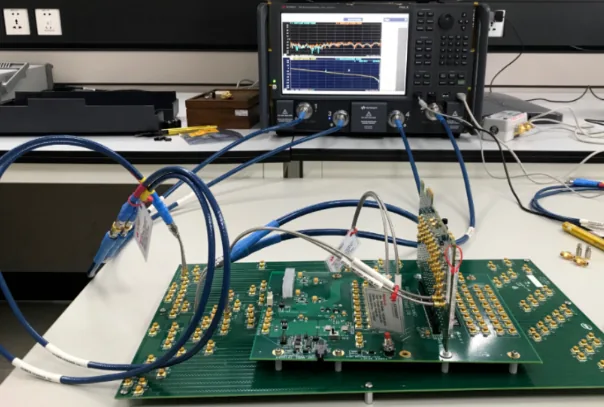
For controlled-impedance builds, TDR-measured impedance coupons are included on every production panel with measurement data recorded against simulation targets. Extended validation options include VNA S-parameter sweeps on dedicated test vehicles through 40 GHz, cross-section micrograph analysis, IST reliability testing, and full IPC-6012 Class 3 documentation packages with serialized board traceability.

For automotive programs, we follow IATF 16949 quality practices. For aerospace and defense programs, extended documentation packages including environmental test reports, microsection micrographs, and material traceability certificates are available per customer specification.

PTFE VNA validation

Industry Applications

Global Industries Relying on Our PTFE PCBs

PTFE substrates serve the most demanding applications across telecommunications, automotive, aerospace, defense, and RF markets, especially in advanced microwave PCB and mmWave signal chains.

Telecommunications

5G & Wireless Infrastructure

Massive MIMO antenna panels and beamforming feed networks for sub-6 GHz and mmWave 5G base stations. Taconic RF-35 and Rogers RO4350B offer cost-effective sub-6 GHz solutions, while RT/duroid and TLY provide the extreme low-loss required for mmWave patch array feed networks.

Satellite & Space

SATCOM & LEO Terminals

VSAT terminal RF front ends, LEO phased-array user terminals, and GEO transponder power amplifier boards. RT/duroid 5880 and TLY-5A's ultra-low loss preserves the receive-chain link budget to maximize G/T sensitivity.

Defense

Military Radar & Electronic Warfare

AESA radar transmit/receive modules, electronic warfare wideband receivers, and jamming arrays. Pure PTFE substrates have MIL-qualified heritage on operational platforms demanding 20+ year field reliability under extreme thermal cycling and salt fog exposure.

Automotive

24 GHz & 77 GHz ADAS Radar

Short-range and long-range automotive radar sensor front ends. Rogers RO3003 is the industry benchmark for 77 GHz ADAS due to its extreme Dk stability over temperature. CER-10 (Dk 10.0) is utilized for severe antenna miniaturization.

Test & Measurement

Calibration & Reference Standards

VNA calibration substrates, reference transmission line standards, and probe-station interposers. TLY-5A and RT/duroid's tightly controlled dielectric properties, with Dk variation less than +/-0.5%, make them the preferred substrates for metrology-grade measurement fixtures.

Industrial & IoT

Commercial Connectivity

Wi-Fi 6/7 front-end modules, LoRaWAN concentrator boards, and industrial radios. Ceramic-filled PTFE such as RF-35 balances RF performance and cost for high-volume commercial products below 6 GHz.

Material Selection Guide

PTFE Material Selection Guide for High-Frequency Engineers

Below 10 GHz - Thermoset RF Alternatives (RF-35, RO4350B, Astra MT77)

For commercial RF applications below 10 GHz where ultra-low-loss pure PTFE is not strictly required, thermoset alternatives like Rogers RO4350B and Isola Astra MT77 provide good RF performance with standard FR-4 processing. Taconic RF-35 offers excellent loss characteristics but still requires plasma. These are the lowest total-cost RF options and are stocked at APTPCB.

6-40 GHz with Moderate Loss Budget - Ceramic-Filled PTFE

For radar T/R modules, base-station filters, satellite IF processing, and automotive radar, ceramic-filled PTFE laminates such as Rogers RO3003 and Taconic TLX provide excellent performance. RO3003 remains the 77 GHz ADAS standard thanks to tight Dk tolerance over temperature.

Above 20 GHz or Ultra-Low Loss - Pure Woven and Microfiber PTFE

For Ka-band SATCOM, E-band links, and military Ka/Q-band radar, Rogers RT/duroid 5880 and Taconic TLY-5A deliver the absolute lowest dielectric loss available in commercial PCB laminates. Our factory processes both with equivalent plasma desmear, drill, and lamination workflows.

Miniaturized Antennas - High-Dk PTFE

For antenna miniaturization, Taconic CER-10 and Rogers RO3010 enable antenna elements about 0.32x the linear dimensions of designs on Dk 3.5 substrates. The trade-off is higher dielectric loss compared to pure PTFE.

The optimal PTFE laminate depends on three primary factors: operating frequency, acceptable insertion loss, and cost sensitivity. Here is a practical selection framework based on our manufacturing experience across thousands of RF builds.

FAQ

Teflon / PTFE PCB Manufacturing FAQ

Which PTFE brands and laminates do you process?
We process all major commercial PTFE and Teflon-equivalent laminates, including Rogers Corporation (RT/duroid series, RO3000 series), Taconic / AGC (TLY, TLX, TLC, CER, and RF series), and Arlon / AGC (CLTE-XT, DiClad, CuClad). We maintain validated plasma-etch, drilling, and hybrid lamination recipes for each formulation, including programs that specify Arlon microwave and polyimide materials alongside PTFE layers.
Do all PTFE materials require plasma desmear?
Yes. Pure PTFE and ceramic-filled PTFE substrates are chemically inert to standard alkaline permanganate used in FR-4 PCB desmear. To ensure reliable plated through-holes, the PTFE hole wall must be activated using plasma desmear or sodium-naphthalenide chemical etching. Non-PTFE thermosets such as RO4350B or Astra MT77 do not require plasma.
Which PTFE materials do you stock for quick-turn production?
We maintain local inventory of Rogers RT/duroid 5880, RO3003, and RO4350B; Taconic TLY-5A, RF-35, and CER-10; plus associated bonding prepregs such as fastRise 27 and RO4450F. Non-stocked models and unusual thicknesses can be expedited through authorized distributors within 5-10 working days, while stocked combinations can move directly into quick-turn RF production.
Can PTFE substrates be hybridized with standard FR-4?
Absolutely. Hybrid stack-ups are recommended to optimize cost for demanding PCB stack-up designs. We frequently bond PTFE signal layers to structural FR-4 power and ground cores using low-loss bonding prepregs such as fastRise 27 or RO4450F, while carefully managing the CTE mismatch to ensure flat, reliable boards.
What surface finishes do you recommend for PTFE RF boards?
For high-frequency RF signal traces, immersion silver is the top recommendation because it provides low surface resistivity and minimizes skin-effect conductor loss. ENIG is reliable for assemblies with fine-pitch SMT components, while ENEPIG is recommended when passive intermodulation is a concern. HASL is not recommended for RF applications.
What is the typical lead time for a PTFE PCB prototype?
For stocked materials such as standard thicknesses of RF-35 or RT/duroid 5880, simple 2-layer RF boards can be manufactured in 3-5 working days. Multilayer or hybrid PTFE/FR-4 constructions typically require 7-10 working days due to added plasma desmear and sequential lamination steps.

Interactive Tool

PTFE Material Cross-Reference Selector

Compare PTFE laminates across Rogers, Taconic, and Arlon. Select by Dk range to find equivalent substrates from different manufacturers.

Select by Dielectric Constant Range
Select a Dk range to compare PTFE materials across manufacturers.

Global Engineering Reach

PTFE PCB Manufacturing for Engineers Worldwide

Military satellite receivers, automotive radar sensors, and 5G mmWave antenna panels worldwide rely on PTFE substrates. APTPCB processes all major PTFE laminate brands and ships globally with DFM review and TDR-validated delivery.

North America
USA · Canada · Mexico

Defense contractors, telecom OEMs, and hardware startups across the US and Canada rely on APTPCB for prototype and NPI builds. Same-day DFM review. ITAR-aware documentation is available on request.

DefenseSatelliteITAR-Aware
Europe
Germany · UK · Sweden · France

Automotive radar suppliers in Germany, defense electronics teams in the UK and France, and Scandinavian wireless R&D labs source prototypes and production-intent boards through our platform.

ADAS RadarEW SystemsAerospace
Asia-Pacific
Japan · South Korea · Taiwan · India

5G base-station manufacturers, satellite terminal developers, and hardware startups across APAC use our online quoting platform for prototypes and NPI runs with 24-hour DFM response.

5G mmWaveSATCOMNPI
Israel & Middle East
Israel · UAE · Saudi Arabia

Aerospace radar, defense EW, and SATCOM programs in the region rely on our extended qualification documentation packages and material traceability for defense procurement compliance.

Defense RadarSurveillanceSATCOM

Start Your PTFE PCB Project

Share your Gerber files, material requirements, impedance targets, and performance specifications. Our engineering team will return a validated stack-up proposal, DFM review, and detailed quotation within one business day.