
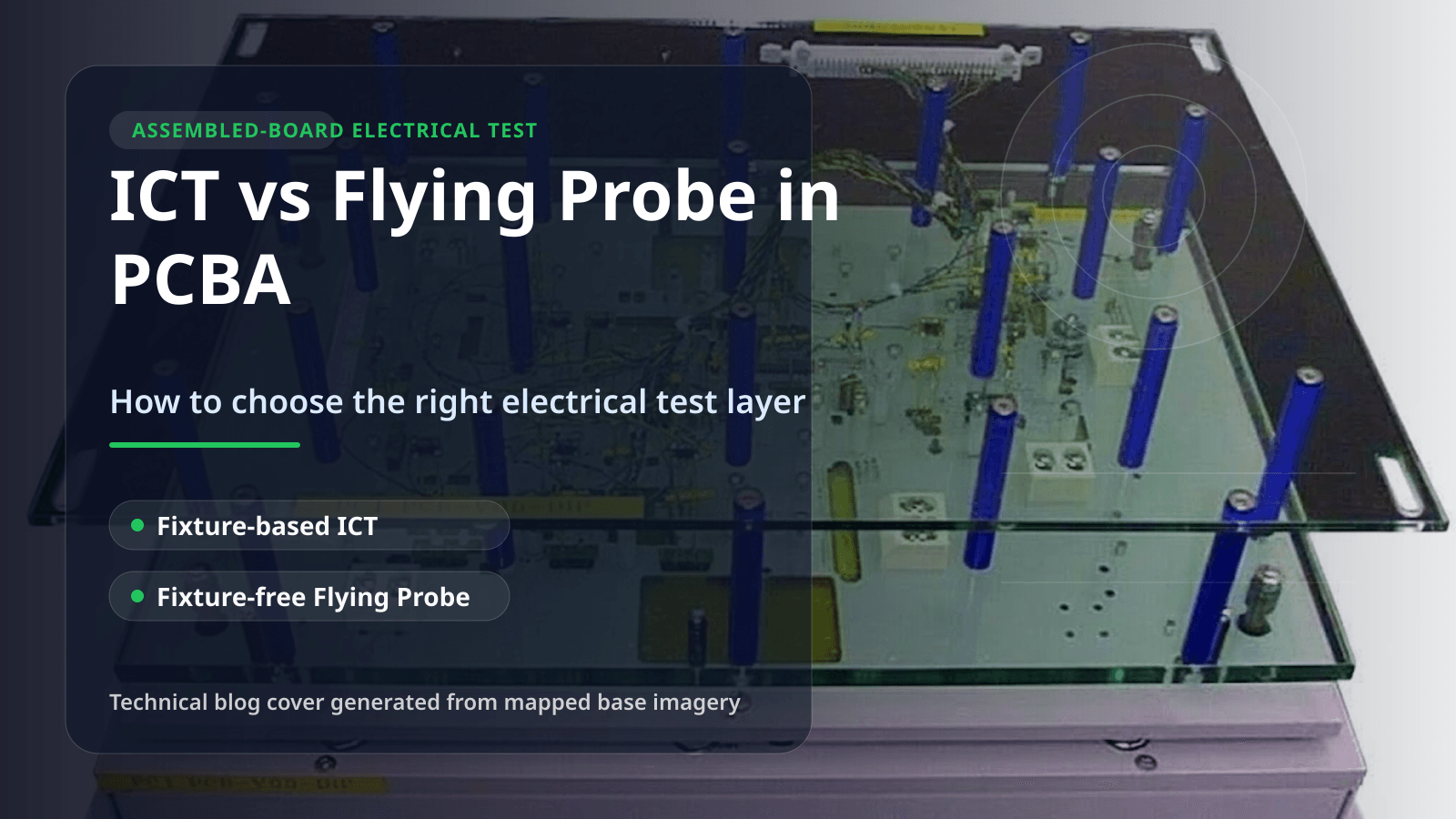
- ICT and flying probe are both assembled-board electrical test methods, but they do not fit the same build conditions.
- The most useful boundary is simple: ICT is a fixture-based electrical method, while flying probe is a fixture-free electrical method.
- Neither method should be described as a replacement for SPI, AOI, X-ray, or functional test, because those layers answer different questions.
- A board can pass flying probe and still fail functional test. A board can pass ICT and still need hidden-joint inspection or release review.
- The right decision usually comes from build stability, access planning, and test intent rather than from generic claims about one method being universally better.
Quick Answer ICT and flying probe both screen assembled-board electrical faults such as opens, shorts, and component-level issues, but they fit different operating conditions. ICT is the stronger fit when the program supports fixture-based access and stable test planning. Flying probe is the better fit when the build is still changing, lower volume, or not ready for fixture commitment. The decision is not which method is "best" in general. The decision is which electrical-test lane matches the board's access model, design maturity, and release path.
For the broader quality-stack view that connects SPI, AOI, X-ray, ICT, flying probe, functional test, and release gates, start with the PCBA Assembly Test and Quality Guide.
Table of Contents
- What should engineers review first?
- What do ICT and flying probe actually check?
- How do ICT and flying probe differ?
- When does ICT fit better?
- When does flying probe fit better?
- What should be frozen before choosing one path?
- Next steps with APTPCB
- FAQ
- Public references
- Author and review information
What should engineers review first?
Start with test intent, access model, design stability, and downstream validation needs.
That order matters because ICT vs flying probe is often treated as a simple equipment comparison. The stronger engineering question is:
Which electrical-test method fits the board's access plan and release path without being asked to prove something outside its lane?
The first review questions should be:
- Is the main goal electrical defect screening on the assembled board?
- Does the design support a fixture-based access model, or is the program better served by a fixture-free path?
- Is the layout and test plan stable enough to justify a more committed electrical-test setup?
- What later gate still owns powered behavior, hidden-joint review, or shipment release?
| Review axis | What to check | Why it matters | What it does not prove |
|---|---|---|---|
| Test intent | Whether the goal is assembled-board electrical fault screening | Keeps the method in the correct lane | Powered end-use behavior |
| Access model | Whether the board supports fixture-based access or needs a fixture-free path | Access planning shapes the method choice | That all important risks are already covered |
| Design stability | Whether the build is still changing or is now more stable | Stable and changing programs tolerate different test setups | Final customer release by itself |
| Downstream gates | Which later layer still owns function, hidden joints, or final acceptance | Electrical test is only one layer in the stack | That one electrical test method replaces all others |
What do ICT and flying probe actually check?
Both methods belong to the electrical defect-screening layer for assembled boards.
That means they are used to look for issues such as:
- opens
- shorts
- connectivity problems
- some component-level electrical faults
- some orientation or value-related electrical problems, depending on the test plan
That does not mean they automatically prove:
- visible assembly geometry
- hidden-joint integrity under concealed packages
- powered product behavior in the target application
- full release readiness on their own
This boundary matters because ICT and flying probe are sometimes described too loosely as if they prove that the whole board was fully tested. They do not.
They sit after assembly as electrical verification methods. Other layers still own optical review, hidden-joint inspection, powered behavior, and final release governance.
How do ICT and flying probe differ?
The cleanest way to compare them is by access posture and program fit.
| Method | What it mainly answers | Best-fit posture | What it does not replace |
|---|---|---|---|
| ICT | Whether the assembled board passes fixture-based electrical verification | Programs with suitable access planning and a stable electrical-test path | AOI, X-ray, or functional test |
| Flying probe | Whether the assembled board passes fixture-free electrical verification | Prototypes, lower-volume work, or changing builds where fixture commitment is less attractive | AOI, X-ray, or functional test |
That difference is more important than broad marketing claims about speed or cost.
The real boundary is:
- ICT belongs to a fixture-backed electrical-test model
- flying probe belongs to a fixture-free electrical-test model
Both remain electrical methods. Neither one becomes:
- SPI for solder paste control
- AOI for visible assembly defects
- X-ray for hidden-joint inspection
- FCT for powered behavior validation
The physical-failure warning matters most when a dense board is pushed into a fixture path without enough support. Probe force and clamp loading can flex the board locally, especially near very small MLCCs or stressed solder joints. The first pass may still look acceptable because the electrical screen only checks the board in that moment. The later problem is latent: local strain can crack a small capacitor or disturb a joint, and the open or short appears only after handling, debug, or later use. That is why ICT vs flying probe is not only a coverage discussion. It is also an access-model and board-support decision.
Related reading:
- In-Circuit Test (ICT)
- Flying Probe Testing
- Testing & Quality
- X-Ray Inspection
- X-Ray Inspection in PCBA
When does ICT fit better?
ICT fits better when the program is ready for a more committed, fixture-based electrical-test path.
That usually means:
- the board and test plan are more stable
- the team wants repeatable fixture-based node access
- electrical defect screening needs to be a formal, planned production gate
- the build is no longer being treated mainly as a changing launch-stage evaluation
The key point is not that ICT is automatically the most complete electrical method.
The key point is that ICT is strongest when the program can support its access model and when the test layer is expected to stay consistent through repeat production.
APTPCB's related pages position ICT as part of a broader stack that can sit alongside AOI, X-ray, and functional test rather than replacing them.
When does flying probe fit better?
Flying probe fits better when the program needs a fixture-free electrical-test path.
That often includes:
- prototype or early-build programs
- lower-volume work
- designs that are still changing
- projects where the team wants electrical screening without early fixture commitment
This is why flying probe should not be described as simply a weaker form of ICT.
It solves a different planning problem:
How do we get assembled-board electrical verification when the design, access plan, or production posture is not yet ready for a fixture-based lane?
That is a legitimate and often useful choice, especially when the main need is flexible electrical screening during design or process change.
The commercial failure pattern is usually not theoretical. An NPI team pushes toward mass production, assumes the layout is "close enough," and spends several thousand to well over ten thousand dollars on a dedicated bed-of-nails ICT fixture before the board revision is truly frozen. Then pilot build or EMC work exposes a small radiated-noise problem. Hardware moves two filter capacitors near the connector, shifts one protection part, or trims a short routing segment. Inside the CAD tool, that looks like a five-minute revision. On the finished ICT fixture, it is a probe-alignment failure across the bottom side.
At that point the fixture is not "mostly reusable." It is scrap, because the probe field, support geometry, and sometimes the harness mapping no longer match the board. Reworking that tooling can take another two to three weeks, and the production schedule stops while everyone waits for a new mechanical build. Flying probe is slower per board, but in this situation it only needs an updated CAD import and a revised test program. That is the real boundary: before comparing raw test speed, check whether the design and test-point map are mature enough to survive fixture commitment without turning a minor revision into tooling scrap.
What should be frozen before choosing one path?
Before choosing ICT or flying probe as the main electrical-test lane, freeze:
- the board revision and assembly intent
- the test objective, including what defect classes electrical test is expected to own
- the access assumptions for fixture-based or fixture-free verification
- the later need for functional test, hidden-joint inspection, or release review
- the release boundary between electrical defect screening and end-use product proof
If those items are still moving, the board can still be tested, but the electrical-test choice should be framed as a working posture rather than a final production rule.
Next steps with APTPCB
If your high-density PCBA is still living through revision churn, if you do not know whether current test-point coverage is physically sufficient for ICT, or if you are trying to avoid burning fixture-tooling cost before the layout is truly stable, treat the test-method decision as an NPI risk review, not a purchasing choice.
Send the Gerber or ODB++ package, IPC-2581 data if available, netlist, BOM, and any mechanical interference drawings through the quote page or to sales@aptpcb.com. APTPCB's DFT and test-strategy team will return a professional Test Access Model & Tooling Risk Audit within 24 hours.
That review is built to answer the questions that usually get missed until money is already gone: whether ICT is physically supportable, where fixture access will collapse, how much real coverage flying probe can still deliver, and whether a small upcoming revision is likely to turn a custom fixture into scrap. The goal is simple: lock the most stable electrical-screening path before you spend thousands of dollars on tooling that dies with the next board spin.
FAQ
Is flying probe the same thing as ICT?
No. Both are electrical-test methods for assembled boards, but ICT is fixture-based and flying probe is fixture-free.
Can flying probe replace functional test?
No. Flying probe screens electrical faults. Functional test still owns powered behavior in the intended use context.
Can ICT replace AOI or X-ray?
No. ICT is an electrical method. AOI owns visible defect review, and X-ray owns hidden-joint inspection where that evidence is required.
When is flying probe usually the better fit?
It is usually the better fit when the program is still changing, lower volume, or not ready for a fixture-based electrical-test path.
When is ICT usually the better fit?
It is usually the better fit when the board and test plan are stable enough to support a committed fixture-based electrical-test lane.
Public references
Keysight In-Circuit Test Systems Public manufacturing-test anchor for ICT as a fixture-based in-circuit test lane.
SEICA Flying Probe Test Systems Public manufacturing-test anchor for flying probe as a fixture-free electrical-test lane.
Murata Probe-Force Precaution FAQ Public manufacturer guidance that probe force can flex the board and crack chips or open solder joints.
TDK MLCC Flex Crack FAQ Public manufacturer guidance that board flex can create latent MLCC open or short failures.
PCBA Assembly Test and Quality Guide Companion page for the broader test stack around SPI, AOI, X-ray, ICT, flying probe, FCT, and release gates.
Author and review information
- Author: APTPCB PCBA test strategy content team
- Technical review: electrical test planning and PCBA quality engineering team
- Last updated: 2026-05-13